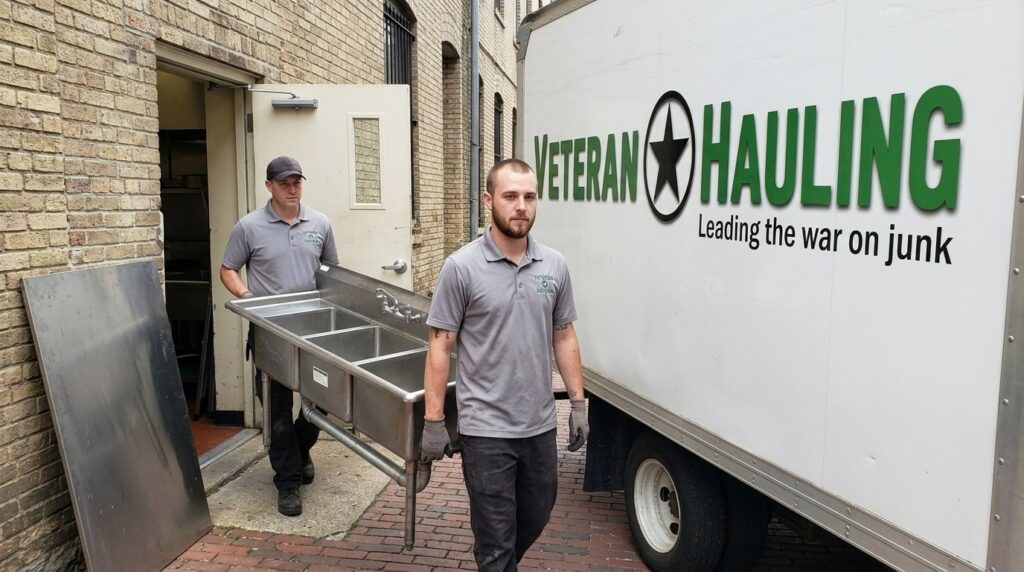
Most guides to closing a restaurant assume the auction handles it: bring in a liquidator, sell the equipment, walk away lighter.
That works in an office and reasonably well in a warehouse. It works worst in a kitchen, because the half of a restaurant that will not sell at any price is also the heaviest, the most bolted down, and the part other trades must touch before anyone loads a truck. When we quote restaurant junk removal in Indianapolis, the conversation is rarely about what the equipment is worth. It is about what is left after the buyers have taken what they want.
Here is what drives the price of an Indianapolis restaurant cleanout, what order the work happens in, and why the sequence matters more than the square footage.
Closing a kitchen in Indianapolis?
Veteran-owned with a 5.0 rating across about 600 Google reviews, we quote by truck volume after walking the space, free and with no obligation.
What Does a Restaurant Cleanout Cost in Indianapolis in 2026?
Here is an unsatisfying answer and why it is the honest one: a restaurant cleanout is quoted on site, by volume, after somebody walks the kitchen.
That is not a dodge. We quote by truck volume rather than by item, and for most work you can estimate that over the phone. A kitchen is the exception, for three reasons. The share of equipment that will sell varies enormously between two restaurants of the same size. The number of trades that must disconnect something before we can lift it varies with the build-out. And the walk-in, the hood and the gas line each carry their own schedule, which changes how many visits the job takes rather than how many cubic yards it fills.
What we can tell you is how the number gets built. Volume in the truck sets the base, broken down in our Indianapolis junk removal pricing guide. On top sit the disconnect trades, the access constraints, and whatever the lease says has to stay. The rest of this guide is those variables, one at a time.
If your space is closer to a storefront than a kitchen, the drivers are different and cheaper, and we cover them in our Indianapolis office cleanout cost guide.
Why Does Indianapolis Restaurant Equipment Removal Cost More Than an Office Cleanout?
Four things separate a kitchen from an office, and none is floor area.
Weight per square foot. An office is mostly air, laminate and hollow steel. A kitchen is stainless, cast iron and compressor motors. A six-burner range, a double-stack convection oven and a three-compartment sink occupy one corner and outweigh a full floor of cubicles.
Nothing rolls out. Office furniture is designed to be moved and reassembled. Commercial kitchen equipment is designed to stay put: bolted to the floor, hardwired to a dedicated circuit, plumbed to a drain, or vented through the roof. Every one of those connections is a step before the lift.
Other trades gate the work. A hauler can carry a desk out today. A hauler is not the one who pulls refrigerant out of a walk-in, and should not be the one capping a gas line. Those are separate visits by separate people, and the cleanout waits on them. The refrigerant rule is EPA’s, and it is the next section.
The resale floor is lower. Used office furniture has a thin market. Used kitchen equipment has a real one, which is why liquidators exist, but it is selective in a way that leaves a specific and heavy remainder behind.
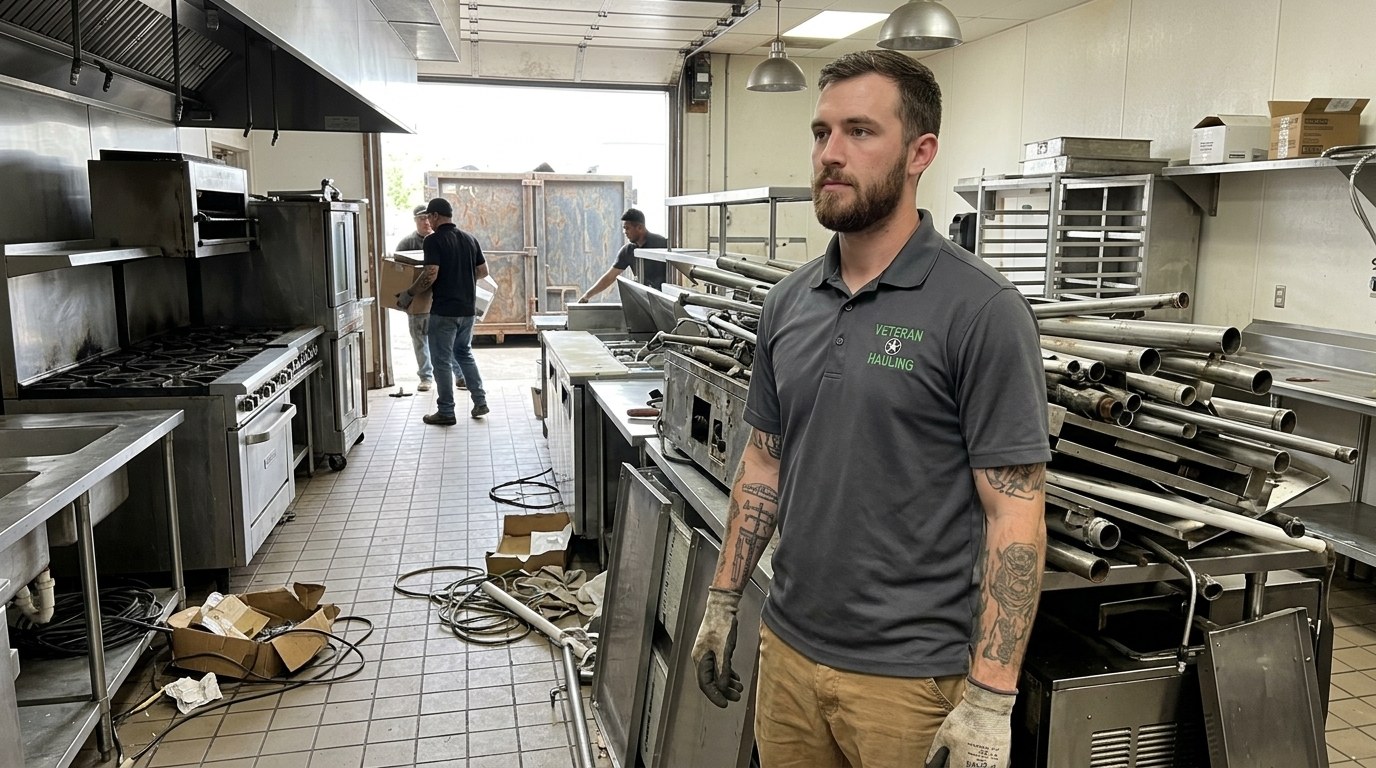
Why Does a Walk In Cooler Teardown Add Days to an Indianapolis Kitchen Cleanout Budget?
The first step is not ours, and cannot be skipped. Per the EPA, refrigeration equipment typically dismantled on site before disposal, and its own example list names retail food refrigeration, must have its refrigerant recovered in accordance with the agency’s servicing requirements before disposal. Those rules sit in Section 608 of the Clean Air Act. A walk-in cooler is exactly that case: it does not leave the building intact, it comes apart panel by panel, and the refrigerant has to come out first. EPA publishes the rule in full in its safe disposal requirements for stationary refrigeration.
The consequence is scheduling, not paperwork. Recovery is servicing work, booked with a refrigeration company on their calendar rather than ours. Until it is done, the walk-in is not a pile of panels, it is a charged system. That is the day, sometimes two, that surprises people who assumed the kitchen came out in one visit.
After recovery the walk-in becomes a demolition job rather than a lifting job. Panels come apart, the condensing unit comes off the roof or the pad, and the floor panel usually fights back. The general refrigerant rules and what our crews charge for built-in and commercial refrigeration are in our guide to refrigerator disposal in Indianapolis.
One booking note that saves a wasted trip: get the recovery scheduled before you book the haul, not after. The reverse order is the single most common reason a kitchen cleanout runs into a second week.
How Much Do Indianapolis Crews Quote to Remove a Commercial Hood System?
A hood is quoted on a walkthrough, and the range is wide rather than hedged. A commercial hood is not an appliance on a wall. It is a welded stainless canopy, ductwork that usually penetrates the roof, an exhaust fan up there, and a fire suppression system plumbed into the assembly. Four things drive the number:
- The fire suppression system. It has to be disarmed and disconnected by the company that services it before anything is cut. That is a separate trade with its own schedule.
- The roof penetration. Pulling the duct and the fan leaves a hole. Somebody has to patch it, and whether that is your problem or the landlord’s is a lease question.
- Grease loading. Ductwork that has not been cleaned in years is heavier, messier and slower to handle than clean duct.
- Access. A canopy that came in before the walls went up does not always come out the way it went in.
Before you price any of that, check whether the hood is yours. On a leased space the fixtures are frequently the landlord’s rather than the tenant’s, which is the point the next section turns on.
Which Indianapolis Restaurant Equipment Has No Auction Value and Must Be Hauled?
This decides the size of your cleanout, and it is more of the kitchen than most operators expect.
Equipment sells when it is portable, current and in demand: reach-in refrigerators, mixers, slicers, ice machines, smallwares. It does not sell when it is bolted, hardwired, plumbed or vented. That means the hood and its ductwork, the gas-connected cooking line, the walk-in panels, built-in booths, the bar structure, and anything cut to fit a room it will never sit in again.
An operator who builds out second-generation restaurant spaces for a living put the value side bluntly in a thread about buying a closed restaurant: the space and the items inside it are worth virtually zero, and the only things worth selling are the business and, depending on location, the liquor license. Another commenter in the same thread noted that nothing about used restaurant equipment suggests it appreciates. Both are talking about the sellable half. The unsellable half is what we come for.
There is a third route between selling and hauling, and it is the most upvoted answer we found anywhere in our research: donate the working, unsellable middle to a culinary program. On a thread about clearing an inherited kitchen, the top answer by a wide margin was to try a community college culinary program, with a public high school teacher replying that programs like theirs would jump at the chance because maintaining and replacing common equipment is one of their biggest costs. Call the programs near you and ask before you pay to haul working equipment. It costs a phone call.
What is left after selling and donating is the auction-proof remainder, and in a kitchen that remainder is bigger and heavier than in any other kind of commercial cleanout. That is the load we price.
Restaurant closing in central Indiana?
Veteran-owned crews clear the auction-proof half after the buyers have gone, 5.0 rating across about 600 Google reviews, free on-site walkthrough.
What Fees Does an Indianapolis Landlord Add for an Unfinished Restaurant Cleanout?
Read the lease before you book anybody. It decides two things that change the job.
What is yours. On a leased restaurant, fixtures are often the landlord’s property rather than the tenant’s. A commenter in the second-generation thread made the point directly, that on a lease the fixtures such as the bar, the sinks and the hoods are typically the landlord’s and not the tenant’s, and advised getting a copy of the lease before assuming otherwise. Removing something that is not yours is worse than leaving it.
What the landlord wants left behind. This surprises people. A landlord may prefer the equipment to stay so the space can be marketed as move-in ready. One commenter on a thread about closing a restaurant described landlords asking for liquidated damages to break a lease, and noted those damages can take the form of keeping your equipment rather than cash. If that is on the table, a full cleanout is the wrong job and you would be paying to reduce your own negotiating position.
Where a landlord does require the space cleared, the lease standard is usually swept and free of stored materials, ready for inspection. If it is not met, the landlord clears it and bills you, and that bill is not competitive because nobody shopped it. The broader math of a clock-driven surrender against a liquidation is worked through in our central Indiana warehouse cleanout cost guide, and it applies to restaurants too.
How Do Grease Traps and Gas Lines Change an Indianapolis Kitchen Cleanout Estimate?
Two systems in a commercial kitchen belong to somebody other than the hauler, and both need handling first.
Grease. Per Citizens Energy Group, restaurants and other food preparation establishments in its service area are required to install grease interceptors, commonly called grease traps. A trap that is still full is not something a cleanout crew empties into a truck; it is pumped out by a grease hauling company. Schedule that separately, and do it before the kitchen is dark, because a trap that sits after the water is shut off gets worse rather than better.
Gas. Every gas-connected appliance in the line has to be disconnected and capped properly, which is work for a qualified gas professional or the utility rather than for a moving crew. We will not pull a range off a live gas connection, and no reputable hauler will.
Fryer oil and cleaning chemicals fall in the same category. We do not haul paint, chemicals, fuel or oil, so used fryer oil goes to a rendering service and the chemical shelf to a hazardous waste route rather than into our truck. Sorting that out before the crew arrives keeps the quote accurate.
How Early Should a Closing Indianapolis Restaurant Get a Cleanout Estimate?
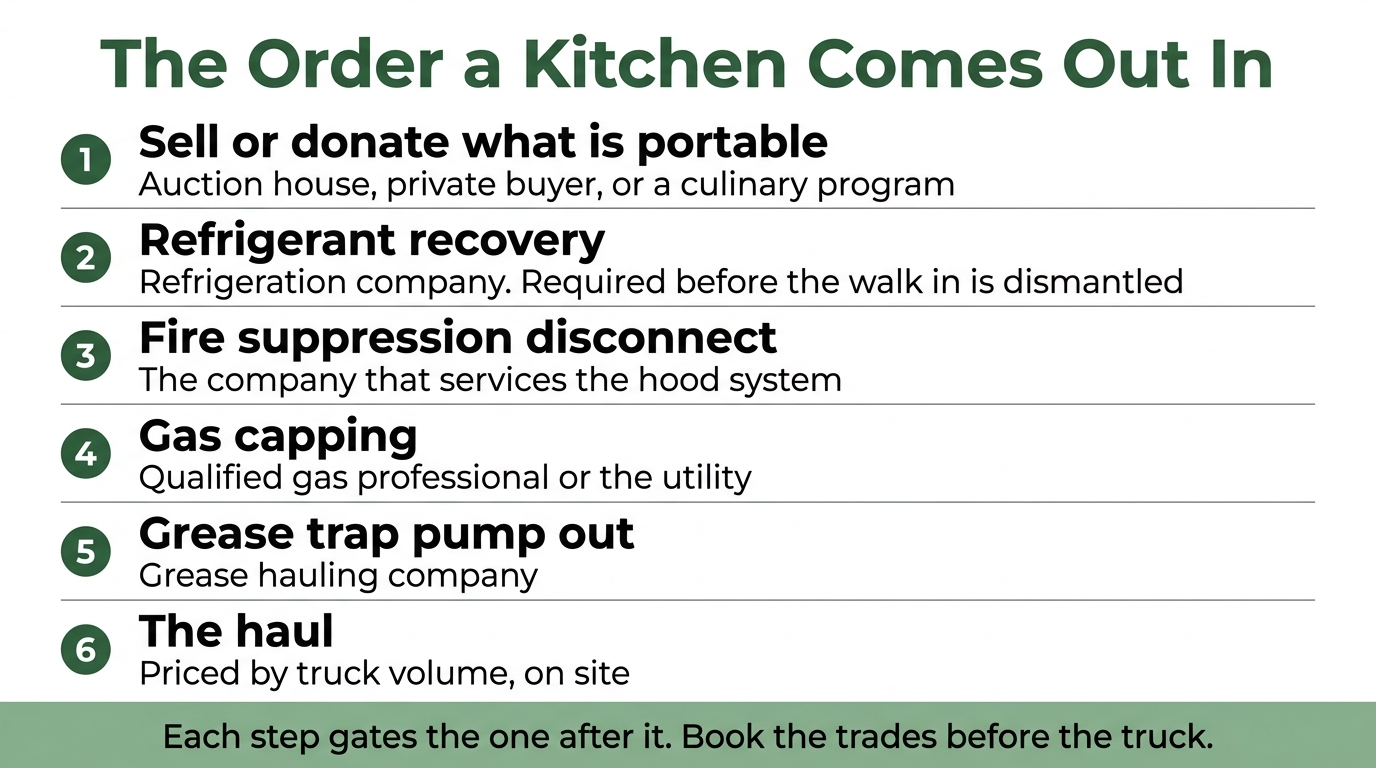
Earlier than feels necessary, and the reason is the queue rather than our calendar. Work backward from the date you hand back the keys. The haul is last. Before it sit the auction or private sale, the donation pickups, the refrigerant recovery, the fire suppression disconnect, the gas capping and the grease trap pump-out. Each is a different company with a different lead time, and several cannot run in parallel because one uncovers the next.
A walkthrough is the cheapest thing in that sequence and the one that tells you the order. Our crews quote on site at no cost, and the walkthrough is usually where an operator learns the hood belongs to the landlord or the walk-in needs a refrigeration visit first. Knowing that four weeks out is a scheduling problem. Knowing it four days out is an expensive one.
For operators handing back multiple sites, we run the recurring version through our commercial cleanout crews.
The Bottom Line on Indianapolis Restaurant Cleanout Costs
A restaurant cleanout is priced by what is left, not by what the kitchen is worth, and that share is unusually large because the auction only wants what is portable.
So: read the lease first, because the hood and the bar may not be yours and the landlord may want them left. Sell what is portable. Call a culinary program about the working middle before you pay to haul it. Book refrigerant recovery, fire suppression disconnect, gas capping and the grease trap pump-out before the truck, because each one gates the load. Then price the remainder by volume.
We are veteran-owned, founded in 2020, insured with general liability and workers’ compensation, and we hold a 5.0 rating across about 600 Google reviews. Every crew member completes a 49-video training course and four weeks of hands-on training before working a job like this. We quote by truck volume after walking the space, and the estimate is free with no obligation.