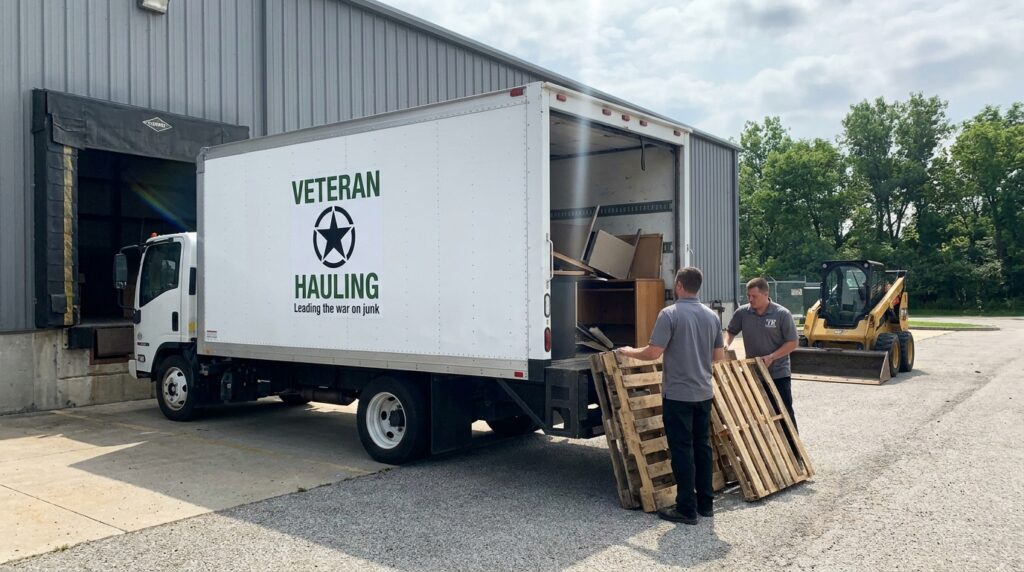
If you own a warehouse, manage one for a property group, or are closing out a leased industrial space in central Indiana, the cleanout quote you get is usually the biggest line item between you and a clean lease surrender or a finished liquidation. We have run warehouse and industrial cleanouts across Indianapolis, the I-65 corridor, Plainfield, Whitestown, Greenwood, Lebanon, Fishers, Noblesville, Avon, and Brownsburg since 2020. The gap between a $3,500 small-warehouse turn and a $42,000 multi-day liquidation comes down to four things: cubic volume (floor area times ceiling height), pallet and racking density, hazmat exposure, and how many days before the landlord or receiver expects the keys. Most operators bidding against us here are residential junk-removal companies that “also do commercial,” and the quotes show it. We own our skid-steer outright, we run a two-truck fleet on every commercial job that warrants it, and we are insured with GL + workers’ comp at the levels every central Indiana industrial landlord will actually verify on the certificate. Our team handles owner and property-manager walkthroughs directly through our Central Indiana commercial cleanout services program.
This guide covers what warehouse and industrial cleanouts cost in central Indiana in 2026, what should be in a real line-item quote, how end-of-lease cleanouts price differently from liquidations, what hazmat and pallet disposal adds, and the red flags in a cheap quote. For owners with interior scope (office build-out tear-out, racking removal, mezzanine demo), we cover that through our central Indiana demolition crew as a paired engagement so you are not coordinating two vendors against the same surrender date.
Need a warehouse cleanout quote before the lease clock runs out?
Veteran-owned with 600+ five-star reviews across central Indiana, two trucks plus an owned skid-steer on every industrial job that calls for one, insured with GL + workers' comp at the levels any landlord will verify, and a free on-site walkthrough that gets you a flat written number before any contract.
What does a Central Indiana warehouse cleanout actually cost in 2026?
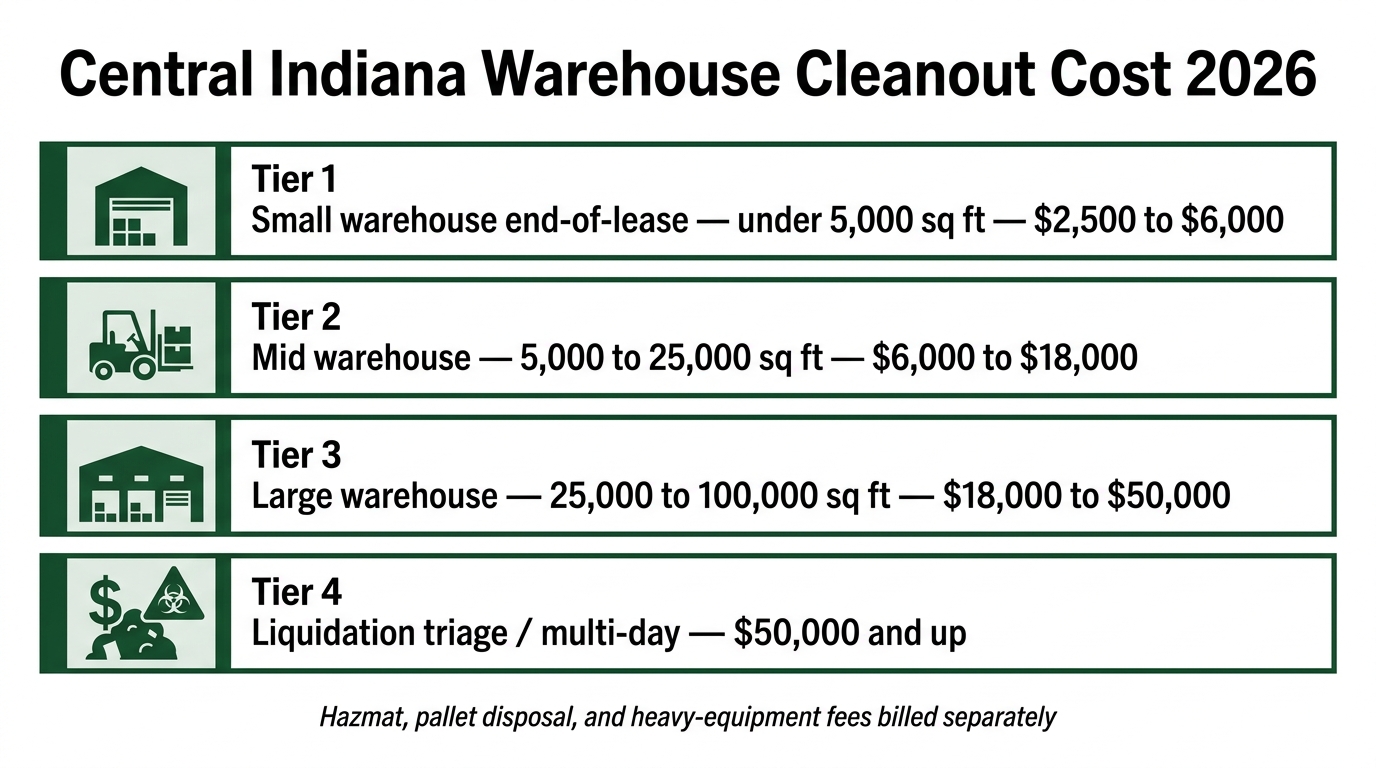
For most central Indiana warehouse and industrial cleanouts we quote in 2026, pricing breaks down like this: $1,200 to $3,500 for a small pallet-only floor sweep (under 2,500 sq ft, low ceilings, no hazmat, no racking demo), $3,500 to $8,500 for a mid-size end-of-lease cleanout (2,500 to 5,000 sq ft, standard 16-foot ceilings, light racking), $8,500 to $22,000 for a large warehouse cleanout (5,000 to 25,000 sq ft, taller ceilings, full racking demo), and $22,000 to $50,000+ for a full liquidation or multi-day distribution-corridor turn (25,000 sq ft and up, hazmat tiers, forklift add). The biggest swing inside each tier is cube volume, not floor area, the part a Craigslist hauler cannot see from a phone photo.
National chains ranking on “warehouse cleanout cost” will quote a tier or a per-sq-ft rate from photos. We priced a job last year where the owner sent photos of what looked like an empty 8,000 sq ft warehouse. The walkthrough revealed 32-foot ceilings packed with mezzanine inventory, 220 wood pallets behind a partition wall, and a dead forklift in the back. The photo job priced at $6,000 in our head; the real job priced at $24,000.
| Warehouse tier | End-of-lease cleanout | Liquidation cleanout | Notes |
|---|---|---|---|
| Small (under 2,500 sq ft, low ceilings) | $1,200 to $3,500 | $2,000 to $4,500 | Pallet sweep, broom-clean, single truck day |
| Mid (2,500 to 5,000 sq ft, 16-ft ceilings) | $3,500 to $8,500 | $5,000 to $11,000 | Light racking demo, two-truck day typical |
| Large (5,000 to 25,000 sq ft, 24 to 32-ft ceilings) | $8,500 to $22,000 | $12,000 to $35,000 | Skid-steer on site, multi-day work |
| Distribution-corridor (25,000 to 100,000 sq ft) | $22,000 to $50,000+ | $30,000 to $80,000+ | Crew rotation, forklift add, scheduled landfill runs |
| Hazmat surcharge (any tier) | + $500 to $5,000 | + $500 to $8,000 | Tier depends on VSQG / SQG / LQG classification |
| Skid-steer mobilization (any tier) | + $400 to $700 / day | + $400 to $700 / day | Owned, not rented, so no day-rate markup |
| Weekend or sub-48-hour rush | + 20 to 35% | + 20 to 35% | Crew overtime, dump-station scheduling |
Owners who reach us inside 72 hours of the surrender date almost always pay the rush tier on top of the cube tier. We can scramble a two-truck crew and a skid-steer onto an I-70 industrial park warehouse on 48 hours, but the math is the math.
Why does Indianapolis warehouse cleanout pricing scale with square footage and ceiling height?
Floor area is the number most owners default to. On every job we have done, cube volume (square footage times ceiling height) is the price driver, because cleanout crews are clearing what is in the building, not the slab. A 5,000 sq ft warehouse with 32-foot ceilings packed with high-bay racking and a mezzanine holds roughly four times the contents of the same footprint with 16-foot ceilings and no mezzanine. Same lease, same sq ft on the tax record, four times the work.
The industrial cleaning rate benches floating around the SERP (ISSA’s $0.08 to $0.20 per sq ft) anchor what a janitorial sweep costs. Cleanout is not cleaning. Cleanout means clearing contents (pallets, racking, abandoned inventory, dead equipment, hazmat) and leaving the slab broom-ready. We have seen cube rates as low as $0.40 per cubic foot on a near-empty pallet warehouse and as high as $4.50 per cubic foot on a packed-out manufacturer wind-down.
Tall ceilings also change the equipment on site. A 16-foot ceiling job is a manual-pull operation with pallet jacks and our skid-steer parked near the dock door. A 32-foot ceiling job with high-bay racking usually needs a scissor lift on top of the skid-steer.
What’s included in a real Central Indiana warehouse cleanout quote?
A real warehouse cleanout quote should itemize at least seven things before any flat-rate number gets locked in:
- Free on-site walkthrough. Before any number gets sent in writing, we walk the warehouse with the owner, property manager, or receiver. We measure cube, count pallets, identify hazmat, and check every locked room. Anyone quoting from photos is guessing.
- Labor hours by crew size. Most central Indiana warehouse cleanouts run a 3 to 5 person crew across one to four working days. The labor line should show planned crew size and day count, not a single lump figure.
- Truck count and trip count. Our crew runs two box trucks on every commercial job that warrants it, so the customer is not paying for unnecessary landfill trips.
- Skid-steer and heavy-equipment line. Owned, not rented. Rental day-rates get marked up 30 to 50% in most competitor quotes. Skid-steer mobilization is a known cost line, typically $400 to $700 per day equivalent absorbed into the labor stack.
- Landfill tipping fees and scrap credit. Indiana landfill tip fees average around $150 per ton for non-hazardous industrial waste. Steel racking and metal pallets carry a recycle credit that gets shown on the invoice as a deduction, not a hidden margin grab.
- Hazmat handling, if any. Oil-soaked rags, dead forklift batteries, solvents, paint, fluorescent ballasts. These get classified, segregated, and routed through a permitted disposal facility per EPA’s RCRA framework. Itemized, not buried.
- Insurance documentation on request. We are insured with GL + workers’ comp, and we send the COI directly to the landlord or property manager. Every commercial landlord in central Indiana will verify it before crew arrival. Our crew is part of the same trust stack.
How do Central Indiana end-of-lease vs liquidation warehouse cleanout costs differ?
End-of-lease cleanouts and liquidation cleanouts are different jobs with different timelines, scopes, and cost structures. Most owners do not see the distinction until they get two wildly different quotes and cannot figure out why.
End-of-lease cleanout (clock-driven). Your lease has a surrender date and a broom-clean clause. You need everything out by a fixed day, the landlord walks the space, and your deposit is on the line. The scope is binary: cleared and broom-clean by the deadline, or not. Broom-clean is a real standard under OSHA 1910.176 housekeeping principles, spelled out in most commercial lease addendums as “swept, free of stored materials, ready for inspection.” End-of-lease jobs price tighter because there is rarely valuable inventory left to dance around, and typically come in 15 to 30% below comparable-size liquidations.
Liquidation cleanout (asset-triage-driven). A business is winding down, a receiver is involved, or an estate is unwinding an operation. The auction crew comes through first to pull high-value inventory and equipment, then the cleanout crew handles everything else. Volume is larger because the entire operating inventory is in play, and work is slower because the crew has to coordinate around what the auctioneer still wants. Liquidation cleanouts typically run 20 to 40% above comparable end-of-lease pricing on the same cube.
Owners who try to walk away from a warehouse lease without a cleanout almost always end up paying for it anyway, plus a surrender-clause penalty, plus a deposit forfeiture. For an adjacent residential-side cost story, our central Indiana apartment trash-out cost guide walks through the same clock-driven dynamic on the multifamily side.
Lease surrender date inside the next 30 days?
Veteran-owned with 600+ five-star reviews, two-truck capacity plus an owned skid-steer for racking and pallet sweeps, insured with GL + workers' comp on the COI, and same-week scheduling across central Indiana. Free on-site walkthrough gets you a flat written quote inside 24 hours.
How does I-65 corridor warehouse hazmat or pallet disposal affect cleanout cost?
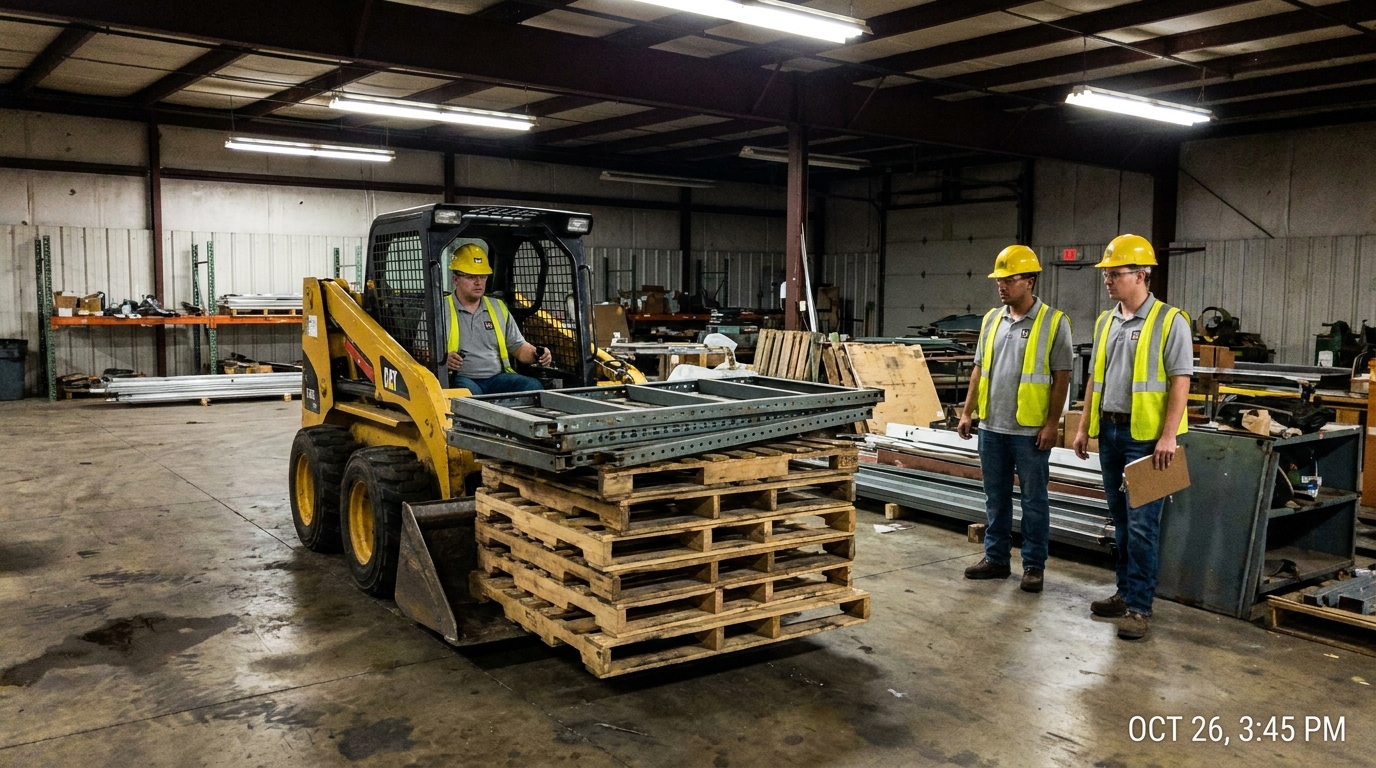
Hazmat is the single biggest cost-line outlier on warehouse jobs, because the disposal path is regulated end-to-end and the per-pound cost is 5 to 50 times non-hazardous disposal. Most warehouse cleanouts we run come in under Indiana’s Very Small Quantity Generator (VSQG) tier (less than 100 kilograms of hazardous waste per month), which keeps the disposal path simple and cheap. A few cleanouts (industrial paint shops, chemical distributors, plating operations) hit Small Quantity Generator (SQG) or Large Quantity Generator (LQG) tiers, requiring a permitted hauler, an RCRA generator ID, and full manifesting. The IDEM hazardous waste generator categories page spells out where each tier kicks in, and we use it to triage every job during the walkthrough.
For non-hazardous industrial waste, Indiana splits waste into Type I through Type IV under the IDEM industrial solid waste framework. Most warehouse contents (broken pallets, abandoned office furniture, packaging waste, dead shelving, general debris) fall into Type III or Type IV and route to standard restricted-waste landfills at the $150 per ton average. Generators are required to characterize their waste before disposal, the kind of compliance step a Craigslist hauler skips and an insured crew like ours does as a matter of course.
Pallets are the other category owners ask about. Heat-treated wood pallets that cleared $17 to $23 each at the covid peak have dropped significantly since. We bundle pallet handling into the cleanout quote because chasing a broker for $4 a pallet on 220 pallets while a $200/day rental clock ticks on the warehouse is a losing math problem for the owner. Our crew sorts, stacks, and either resells (if volume justifies) or recycles, with the recycle credit shown on the invoice rather than pocketed as margin.
What heavy-equipment fees add to a Plainfield warehouse cleanout quote (skid-steer, forklift)?
This is the line item where most owners get the biggest surprise and where our setup is the biggest differentiator. We own our skid-steer outright (a Bobcat-class machine sized for warehouse and distribution-corridor work), so there is no rental day-rate markup to pass through. Most central Indiana competitors quoting warehouse cleanouts are sub-renting their skid-steer from United Rentals, Sunbelt, or Home Depot at $350 to $550 per day, then marking that up 30 to 50% before it hits your quote.
Skid-steer mobilization runs $400 to $700 per day equivalent on our quote, baked into the labor stack rather than carved out as a “rental pass-through.” For most mid-size cleanouts (2,500 to 10,000 sq ft, two to three working days), that comes in around $1,000 to $2,000 across the project rather than the $1,500 to $3,000 a rental-based competitor would show.
Forklift fees are a separate add when needed. A warehouse cleanout with still-loaded racking and palletized inventory often needs an on-site forklift to pull pallets from upper bays before the racking comes down. We either sub-rent a forklift from a Plainfield rental house or coordinate with the auctioneer (on liquidation jobs) to leave theirs on site. Forklift add runs $500 to $1,200 per day depending on capacity and duration. Any forklift operator on the property has to be OSHA-1910.178 certified, and the OSHA warehousing standards spell out why this is not a DIY line item. Scissor lift adds (for high-bay racking dismantle on 24 to 32-foot ceiling jobs) typically run $200 to $400 per day.
When should a Greenwood warehouse owner schedule cleanout vs delay it to budget better?
The clock is the price driver on every warehouse cleanout we have quoted. Three weeks out from the surrender date gets the scheduled rate. 48 hours out gets the rush rate, typically 20 to 35% above scheduled because the crew is working overtime, the dump stations need scheduling exceptions, and we are pulling crew off other booked jobs.
For owners budgeting across a 60 to 90 day wind-down, the smartest move is to book the walkthrough now and lock the flat quote in writing, even if work is six weeks out. Our quotes hold for 60 days from walkthrough date as long as scope does not change.
For owners with hazmat on site, the schedule question is not just budgetary. Indiana’s hazardous waste generator on-site storage limits cap most operations at 180 days (SQG) or 90 days (LQG) before hazmat must move off site. If operations have wound down and hazmat is sitting in the warehouse, the clock on permitted disposal is already ticking.
For owners closing the business entirely, the cleanout pairs with broader wind-down obligations: final tax returns, INTIME closure, and the Indiana DOR business closure filings. Walking the landlord through a clean space before DOR closure is the cleanest sequencing. If scope includes interior demolition (racking removal, office tear-out, mezzanine demo) and the closure timeline is tight, our central Indiana demolition cost guide walks through how we sequence demolition and cleanout in a single engagement.
What are red flags in cheap Central Indiana warehouse cleanout quotes?
Warehouse cleanouts attract a specific cheap-bid hauler: a one-truck residential junk-removal operator who lands a commercial bid by underquoting, then upsells on every line item not in the original number. Here is what to watch for:
- No on-site walkthrough offered. The quote came from phone photos. Warehouse cleanout quotes cannot be accurate without a walkthrough that measures cube, counts pallets, identifies hazmat, and inspects every locked room.
- No certificate of insurance offered. The landlord will not accept the crew on site without GL + workers’ comp on the COI. If a hauler cannot send a COI directly to your property manager, the job is dead before it starts.
- Cash-only pricing. Cash-only usually means no workers’ comp coverage and no real invoice for your accounting team.
- “Per-truckload” pricing with no truck-count guarantee. The structural lever every cheap operator uses to inflate the final bill. If you are paying $400 per truckload and the operator decides the job is six trucks instead of four, you have no recourse.
- No hazmat line on the quote. If hazmat is present and the quote has no separate hazmat line, the operator is either (a) planning to mix it into general waste illegally, or (b) planning to surcharge it later.
- No scrap or recycle credit shown. Steel racking and metal pallets have real recycle value. If the quote has no credit line, the operator is pocketing it as undisclosed margin.
What our quote shows instead: flat-rate written number, COI to the landlord directly, hazmat as a separate line, scrap and recycle credit deducted on the invoice, two-truck capacity locked, skid-steer day-rate shown, and a photo handoff package the landlord can use to release your deposit. If our quote is higher than the cheap bid, the gap is almost always covered by what the cheap bid surcharges on the back end.
How do we quote a Central Indiana warehouse cleanout (and what happens next)?
For most central Indiana warehouse owners and property managers planning a 2026 cleanout, the walkthrough, written quote, and scheduling happen inside the first week.
Step 1: Free on-site walkthrough. You call or fill out the form. Our team books the walkthrough around your operating hours, usually within 48 to 72 hours. We walk the building, count pallets, measure cube, identify hazmat, inspect racking, and photograph the scope. Walkthroughs take 30 to 90 minutes depending on warehouse size.
Step 2: Flat written quote inside 24 hours. You get the quote in writing with every line item itemized (labor, trucks, skid-steer, landfill tipping, hazmat if any, scrap credit, schedule). The quote is flat-rate, locked, and holds for 60 days from walkthrough date as long as scope does not change. No “per truckload” surprises.
Step 3: Schedule the work date. Central Indiana scheduling typically runs same-week to two weeks out for scheduled jobs, 48 to 72 hours for rush. We send a calendar invite, booking confirmation, two-day reminder, and two-hour reminder before crew arrival.
Step 4: Execute the cleanout. Crew arrives in branded trucks in clean gray polos. Two trucks plus our skid-steer (and a sub-rented forklift or scissor lift if scope calls for it). We work zone by zone, segregate hazmat into permitted-disposal routing, sort scrap, and stage waste for landfill runs. Most mid-size cleanouts wrap in one to three working days; large distribution-corridor cleanouts in three to five.
Step 5: Photo handoff and invoice. When the warehouse is broom-clean, we photograph every zone and send the package to the owner and property manager. The landlord walk-through usually happens within 48 hours; the photo handoff protects your deposit if the landlord later claims something was missed. Final invoice goes the same day, with hazmat manifest copies attached if applicable.
If you are managing a warehouse in Indianapolis, Plainfield, Whitestown, Greenwood, Lebanon, Fishers, Noblesville, Avon, Brownsburg, or anywhere along the I-65 distribution corridor and want a flat written quote on your 2026 cleanout, book the walkthrough through the form above. Veteran-owned since 2020, 600+ five-star reviews, insured with GL + workers’ comp on the certificate, two trucks and an owned skid-steer on every job that needs it, and a $10 donation to K9’s For Warriors for every customer who takes a five-star photo with the team.