Almost every guide to getting rid of old tires says the same thing: take them to a tire shop, they have to accept them. That advice is half right, and the missing half is the reason tires end up stacked behind garages across Marion County for years.
Indiana law does require tire retailers to take a waste tire back. It requires it only when you buy a new tire from them, one for one, on the same visit. So the four tires coming off your car today have a free home. The six that have been leaning against the shed since 2019 have none, and no shop is obliged to take them at any price. That gap is where most tire piles come from, and it is what we walk into on garage cleanouts in Indianapolis more often than almost any other single item.
Here is what the law says, every legal route out of Marion County, what each one costs, and where each one stops.
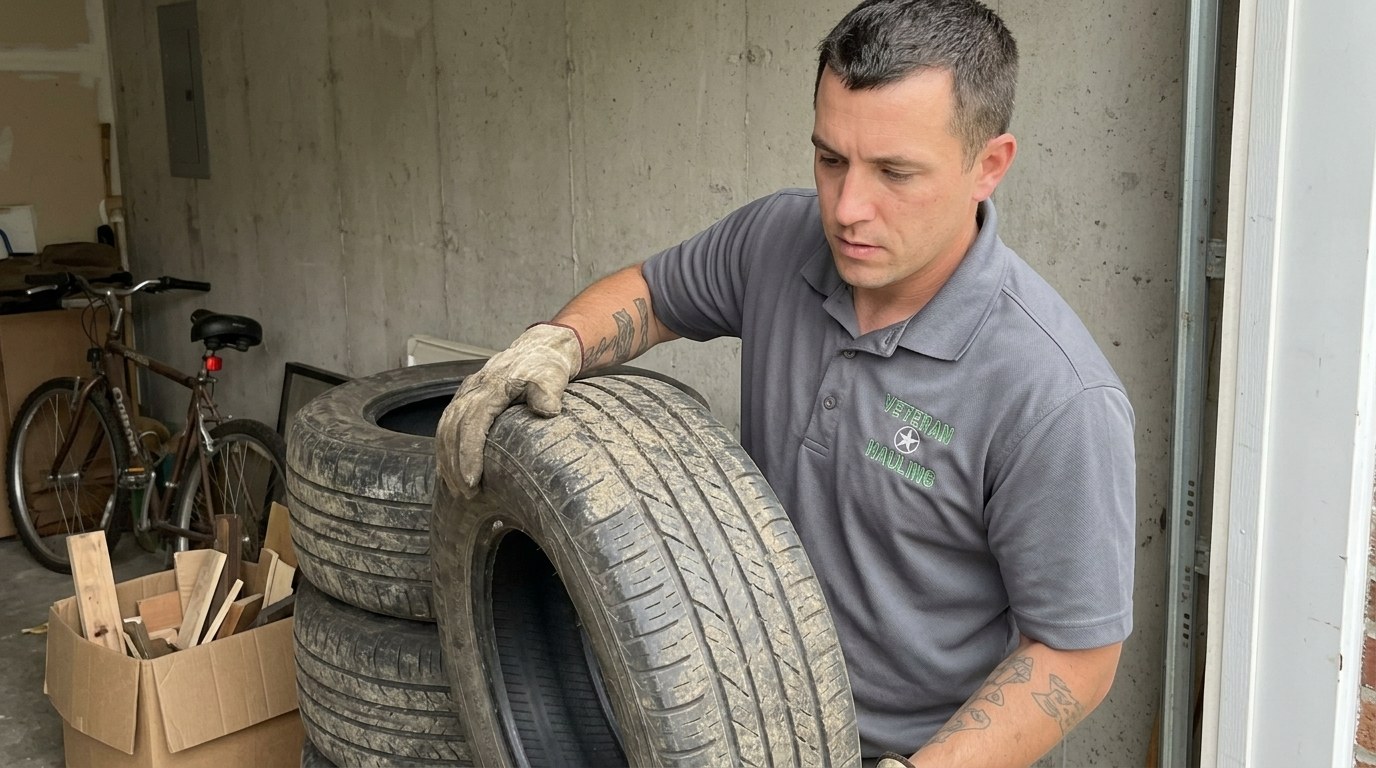
Tire pile in an Indianapolis garage?
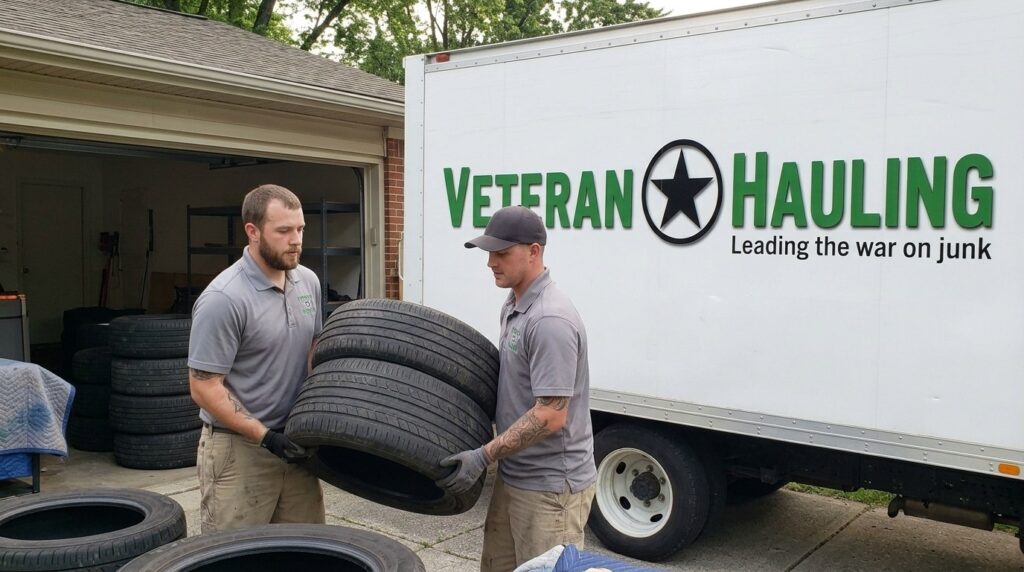
Veteran-owned with a 5.0 rating across about 600 Google reviews, we load tires with the rest of the cleanout in one trip, free on-site walkthrough.
Where Do You Legally Dispose of Old Tires in Indianapolis?
The Indiana Department of Environmental Management sets out the routes a tire generator may legally use. Under Indiana Code 13-20-14-4, per IDEM, proper disposal means handing tires to a wholesaler or its agent, a tire manufacturer, a tire retread facility, a permitted final disposal facility, or a registered waste tire transporter, storage or processing site.
Then IDEM adds the sentence that changes the whole picture. Its waste tire guidance states plainly that none of those parties is required to accept waste tires. The routes are legal, not guaranteed. That single line explains why “just take them to a tire shop” fails so often.
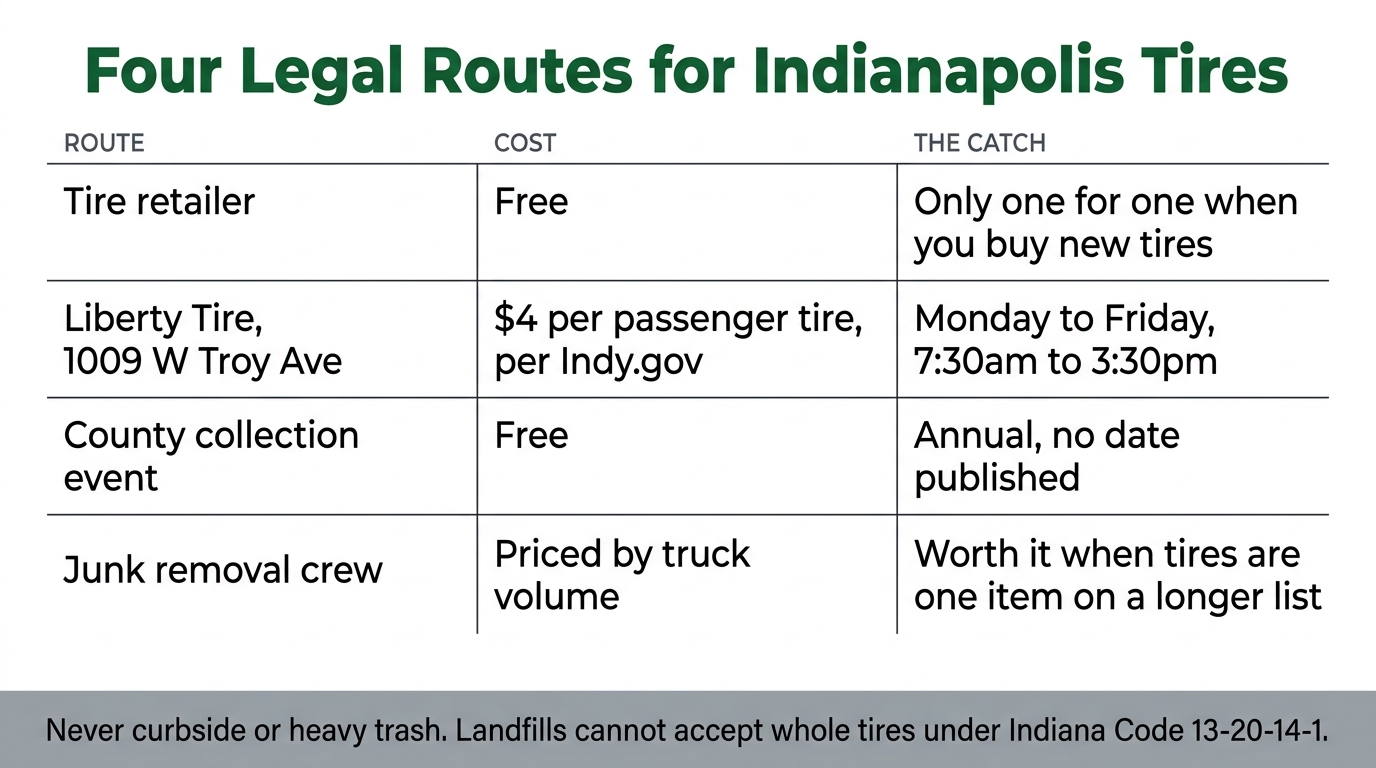
In practical terms, an Indianapolis resident has four options:
- A tire retailer, free but only against a new tire purchase. See the section below on the one-for-one rule.
- A paid drop-off facility. Marion County’s own Recycling 101 guidance names Liberty Tire, which runs a collection facility at 1009 W Troy Ave and accepts tires from the general public.
- A collection event, free but occasional. Covered further down.
- A crew, when the tires are part of a larger pile that has to move anyway.
What is not on that list matters just as much. Per Indy.gov, because landfills cannot accept whole waste tires, by law you cannot dispose of tires through curbside or heavy trash pickup. We have written elsewhere about what the city will and will not collect in our guide to Indianapolis heavy trash limits and refusals, and Columbus draws the same line in its own bulk pickup rules. Tires are refused with rims and without. Take that as settled and start from it.
Why Can’t Indianapolis Landfills Take Whole Tires You Haul In?
The ban is statutory. Per IDEM, landfills cannot accept whole waste tires under Indiana Code 13-20-14-1, with narrow exemptions.
The reasoning is physical rather than bureaucratic, and IDEM states it directly: improperly stockpiled or illegally dumped tires trap rainwater and become breeding grounds for disease-carrying mosquitoes and rodents, and tire piles that catch fire are difficult to extinguish, emit toxic gases into the air, and leave an oily residue that can pollute water and land. A buried whole tire also works its way back to the surface as a landfill settles, which is why they are kept out rather than compacted in.
The exemptions are narrow and none of them helps a homeowner with a trailer. Per IDEM, a landfill may accept a tire that arrives at the working face inside a load of municipal solid waste where removing it would endanger people or equipment, and it may accept solid rubber or foam-filled tires off industrial equipment. Neither covers hauling a stack in yourself.
There is one route around the whole-tire rule: a tire that is no longer whole. IDEM’s guidance describes altering a tire so it is not a whole tire, and notes that disposal facilities may still require additional processing or refuse the material outright. One Indianapolis resident summarized the practice in a local thread as landfills taking tires only once they have been quartered or had the sidewalls cut off. Cutting tires by hand is slow, unpleasant work, and the facility can still say no, so treat it as a last resort rather than a plan.
When Do Indianapolis Tire Amnesty Days Let You Dispose of a Pile for Free?
Free collection events are the best answer for a genuine pile, and they are also the hardest to plan around.
Per Indy.gov, the Marion County Public Health Department’s Mosquito Control Program hosts an annual tire drop-off event for the public during mosquito season, aimed at cutting down breeding grounds. It is a real program and it is free. What Indy.gov does not publish is a date, so the honest instruction is to contact the department directly rather than wait for an announcement to find you.
Outside Marion County, IDEM notes that some solid waste management districts and local government agencies hold tire amnesty days, and points residents to its directory of solid waste management districts to find the one covering their county. Note IDEM’s hedge: some districts, not all. Check yours before loading anything.
If you are holding tires for an event, hold them dry and covered. The mosquito problem IDEM describes starts in your own yard first.
Where Can Indianapolis Drivers Get Rid of Tires Free After Buying New Ones?
This is the rule everyone half-remembers, and the half people drop is the one that matters.
Indiana requires a retailer selling new tires to accept at least one waste tire for each new tire sold, under Indiana Code 13-20-14-3 per IDEM. The same statute chain requires that retailer to post a sign at least 8.5 inches wide by 11 inches high, and IDEM publishes the required wording: “Do not put waste tires in the trash. Recycle your waste tires. State law requires us to accept your waste tires for recycling or proper disposal if you purchase new tires from us.”
Read the last clause again. The condition is written into the sign the shop is legally required to hang on its own wall. The obligation is attached to a purchase, one for one, not to walking in with a pile.
A resident on r/indianapolis put it more bluntly in a thread about tires dumped in a park, in a comment that drew 87 upvotes: “Tire shops are not obligated to accept tires unless they sold you the new ones, and they charge a fair bit when they do.”
Two practical consequences. First, time your replacement: if you are buying tires anyway, bring the old ones the same day and the disposal is included. Second, if a shop does agree to take orphan tires as a courtesy, that is a favor rather than a right, and the price is theirs to set. IDEM also notes that retailers collect a 25-cent fee on each new tire sold and remit almost all of it to the state, so the disposal system is funded at the point of sale rather than at the point of disposal.
What Should Indianapolis Landlords Do With Tires Tenants Clear Out and Leave?
Tires left behind at a turnover are a different problem, because the person who generated them is gone and the property owner inherits the pile.
Two things are worth knowing. IDEM states that it is illegal to open dump or open burn waste tires in Indiana, so the two shortcuts that suggest themselves on a vacant property are both out. And Indiana Code 13-20-13-1.5, per IDEM, requires anyone storing waste tires to do so in a way that protects human health and the environment, does not pose a fire hazard, and controls vectors that can threaten human health. A stack of water-filled tires behind a rental is not a neutral thing to leave sitting.
For a single unit, the tires usually leave with the rest of the trash-out. For a portfolio, the tires are rarely the only surprise, which is why we handle them inside recurring work for property managers rather than as a separate call. Our breakdown of apartment trash-out costs across central Indiana covers how abandoned tires get priced alongside everything else a unit produces.
Tenant left tires behind in central Indiana?
Veteran-owned crews clear turnovers with the tires included, 5.0 rating across about 600 Google reviews, free on-site quote.
Should Indianapolis Drivers Pay to Dismount Tires or Haul Them Away on the Rim?
If your tires are still on their wheels, you have a decision that most guides skip entirely.
The case for dismounting first is that the two halves have opposite economics. A steel or alloy wheel is scrap metal with real value, and scrap metal is one of the easier things to move in central Indiana. The tire is the part you pay to get rid of. Separating them turns one disposal problem into a disposal problem plus a small asset.
The case against is time and cost. Dismounting is shop work, it is priced per wheel, and if you are paying someone to break four tires off four rims you may spend more than the scrap is worth. Facilities also differ on whether they want tires mounted at all, and that is the question to ask before you drive anywhere.
Locally, A & E Tire Recycling on North Shadeland Avenue publishes tire and rim disposal as separate services and states that it handles scrap rim disposal alongside tires of any size. Its own site says fees vary by tire size, type and quantity, so pricing comes from a phone call rather than a published table.
Our rule of thumb: for one or two wheels, dismount, sell or scrap the metal, and dispose of the tire. For a pile of eight or more still on rims, the labor rarely pays, and the sensible move is to have the whole lot taken at once.
When Should an Indianapolis Property Owner Haul a Tire Pile Themselves?
Self-hauling is genuinely the cheapest route for a small number of tires, and it stops being cheapest faster than people expect.
The arithmetic is straightforward at the low end. Per Indy.gov, Liberty Tire’s Indianapolis facility charges $4 per tire for passenger and light truck tires and $12.75 per tire for commercial truck tires from semi tractors or trailers, and accepts tires from the general public Monday through Friday from 7:30am to 3:30pm. Four passenger tires is $16 plus your fuel and an hour of your day. That is hard to beat.
Three things break the math. The first is the hours. Weekday, daytime only is exactly when most people work, and it was the loudest complaint in the local thread quoted earlier, where the same commenter described a twenty mile drive during business hours as the only remaining option in their neighborhood. If Saturday is your only free day, A & E Tire Recycling publishes Monday through Saturday hours until 6:30pm, which solves that specific problem.
The second is volume. Tires are bulky rather than heavy, and a stack of twelve does not fit in a sedan or ride safely in an open truck bed without straps. Two trips turn a cheap errand into an afternoon.
The third is that tires are almost never alone. A garage that produced six tires usually also produced a dead mower, some shelving and a broken exercise bike, and none of that goes to a tire facility. When the tires are one item on a longer list, paying twice for two separate disposal runs is the expensive option. We price by volume in the truck rather than per item, and tires carry a surcharge on top of that because of what disposal costs us. The full breakdown, including that surcharge, is in our Indianapolis junk removal pricing guide.
The Bottom Line on Tire Disposal in Indianapolis
Tires are not hard to get rid of legally. They are hard to get rid of conveniently, and the difference is what fills creeks and vacant lots.
Remember the conditional: a retailer owes you a free take-back only against a new tire purchase, one for one. Landfills cannot take whole tires under Indiana Code 13-20-14-1, and curbside and heavy trash will not take them either. Liberty Tire is the drop-off Marion County names, at $4 per passenger tire during weekday hours. If you work weekdays, a Saturday-open recycler solves that. If your county runs an amnesty day, that is the free answer, and IDEM’s district directory is where to find it.
And if the tires are one line on a longer cleanout, let them ride out with everything else. We are veteran-owned, founded in 2020, insured with general liability and workers’ compensation, and we hold a 5.0 rating across about 600 Google reviews. Our crews quote on site after seeing the volume, and the estimate is free with no obligation.