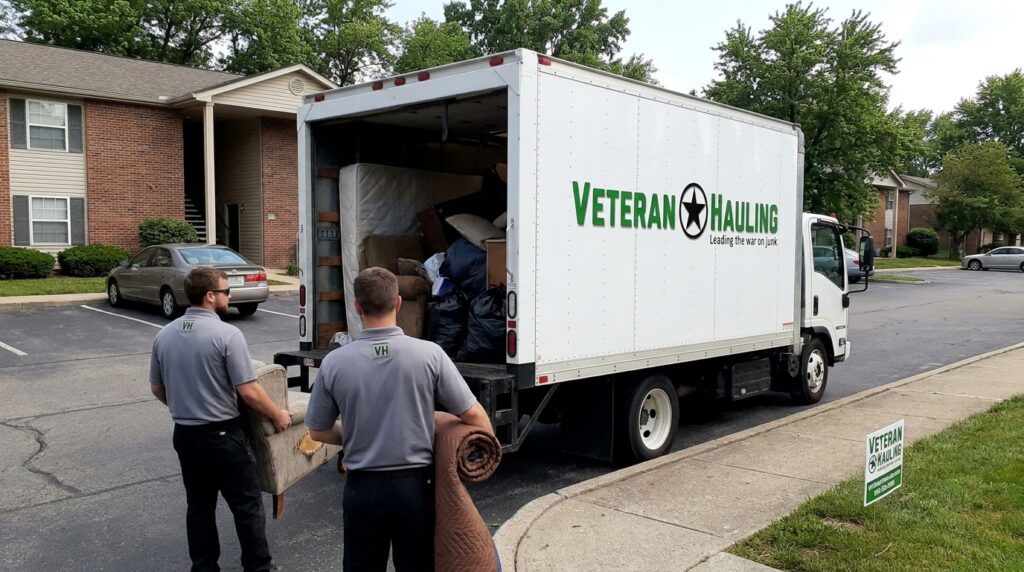
If you manage apartments in central Indiana, you already know that trash-outs are a recurring line item rather than a one-time expense. The unit-turn between an evicted tenant and the next lease-up, the dumpster-overflow weekend after a holiday, the bedbug-affected unit nobody else will touch. Every property manager we work with has a different mix of trash-out scenarios, and almost all of them are getting quoted by national chains as if every job were a one-off retail call. After running apartment trash-outs across Indianapolis, Bloomington, and Columbus since 2020, our crew has learned that the difference between a $400 unit turn and a $1,200 emergency call usually comes down to how predictable your volume is and whether you already have a hauler set up on your property.
This guide breaks down what apartment complex trash-outs actually cost in central Indiana for 2026, what per-unit move-out trash-outs cost, how our optional Apartment Service Plan (ASP) handles recurring dumpster overflow, what should be itemized on every property-manager quote, and the red flags to watch for when a hauler underbids to land your account and then upsells on bedbug units, freon items, or stairs. If you’d rather skip the research and book a walkthrough at the property, our team handles property-manager calls directly through our central Indiana apartment cleanouts program.
Managing an Indianapolis apartment complex?
Veteran-owned with 600+ five-star reviews and property managers across central Indiana who keep us on call for unit turns, insured with general liability and workers' comp at the levels apartment complexes require, and a free walkthrough that gets you a real per-unit number on the spot.
What Does a Central Indiana Apartment Complex Trash-Out Actually Cost in 2026?
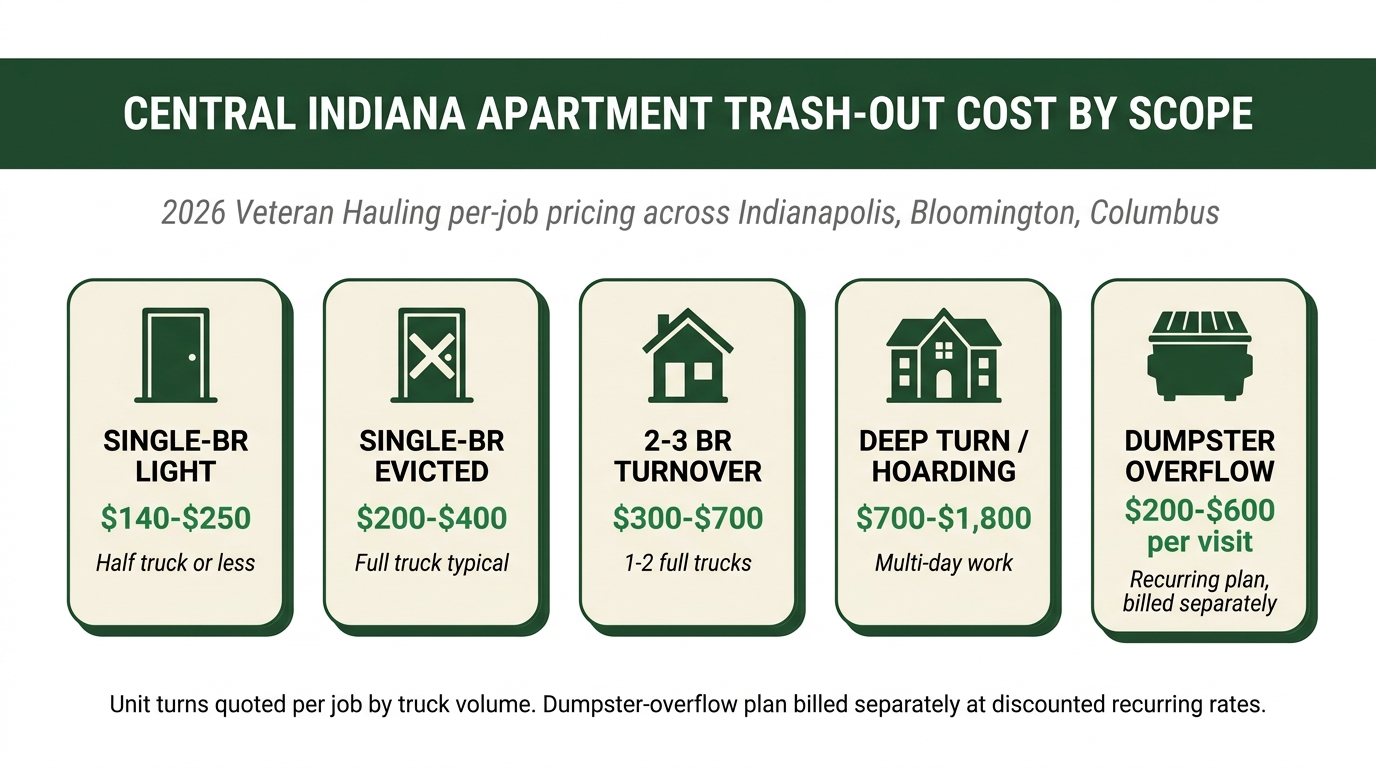
For most central Indiana apartment trash-outs we quote in 2026, real pricing breaks down like this: $140 to $300 per single-unit move-out trash-out (single-bedroom, evicted tenant, light to moderate volume), $300 to $700 per full-apartment turnover (2-3 bedroom, heavy abandonment, furniture and appliances), $700 to $1,800 per “deep” turn (3+ bedroom, hoarding-grade tenant exit, bedbug treatment, or multi-day work). Unit turns are quoted per job by truck volume, not on a per-unit-per-month contract. For properties with chronic dumpster-area overflow, we also offer an optional Apartment Service Plan (ASP): discounted weekly, bi-weekly, or monthly dumpster-overflow cleanup, billed per visit and separate from unit turns.
One-off retail apartment cleanout quotes from national chains (1-800-GOT-JUNK, College Hunks, Junk King franchises) typically run 30-50% above our per-unit trash-out rate because they’re pricing for the volatility of single-call jobs rather than the predictability of a standing property-management relationship. If you’re paying $400 for what should be a $250 turn, you’re paying the retail premium because the operator has no relationship visibility on your property.
Here’s how central Indiana apartment trash-out pricing typically shakes out by scope:
| Scope | Typical central Indiana cost | Notes |
|---|---|---|
| Single-bedroom move-out (light volume) | $140 to $250 | Half-truck or less, no special items |
| Single-bedroom evicted-tenant trash-out (full volume) | $200 to $400 | Full truck typical, possible mattress surcharge |
| 2-3 bedroom full turnover | $300 to $700 | 1-2 full trucks, often includes furniture haul |
| 3+ bedroom deep turn / hoarding-grade exit | $700 to $1,800 | Multi-day work, often staged across visits |
| Bedbug-affected unit (any size) | +$100 to $300 surcharge | Most competitors won’t take these; we do |
| Dumpster-overflow plan (ASP, recurring) | $200 to $600 per visit | Discounted at weekly or bi-weekly cadence; separate from unit turns |
The biggest quote variability we see comes from property managers whose units skew toward extended-stay or short-term-rental abandonment. Those jobs almost always exceed the standard volume tier because tenants leave behind 2-3x the furniture and appliance volume of a typical lease-end. If your property is heavily Airbnb-adjacent or has rolling extended-stay turnover, build the higher tier into your budget assumption.
How Does Our Indianapolis Apartment Dumpster-Overflow Plan (ASP) Differ From Per-Unit Trash-Out Pricing?
This is the most important distinction property managers need to understand about apartment trash-out pricing, and it’s the one almost every national-chain quote obscures. Here’s how the math actually works:
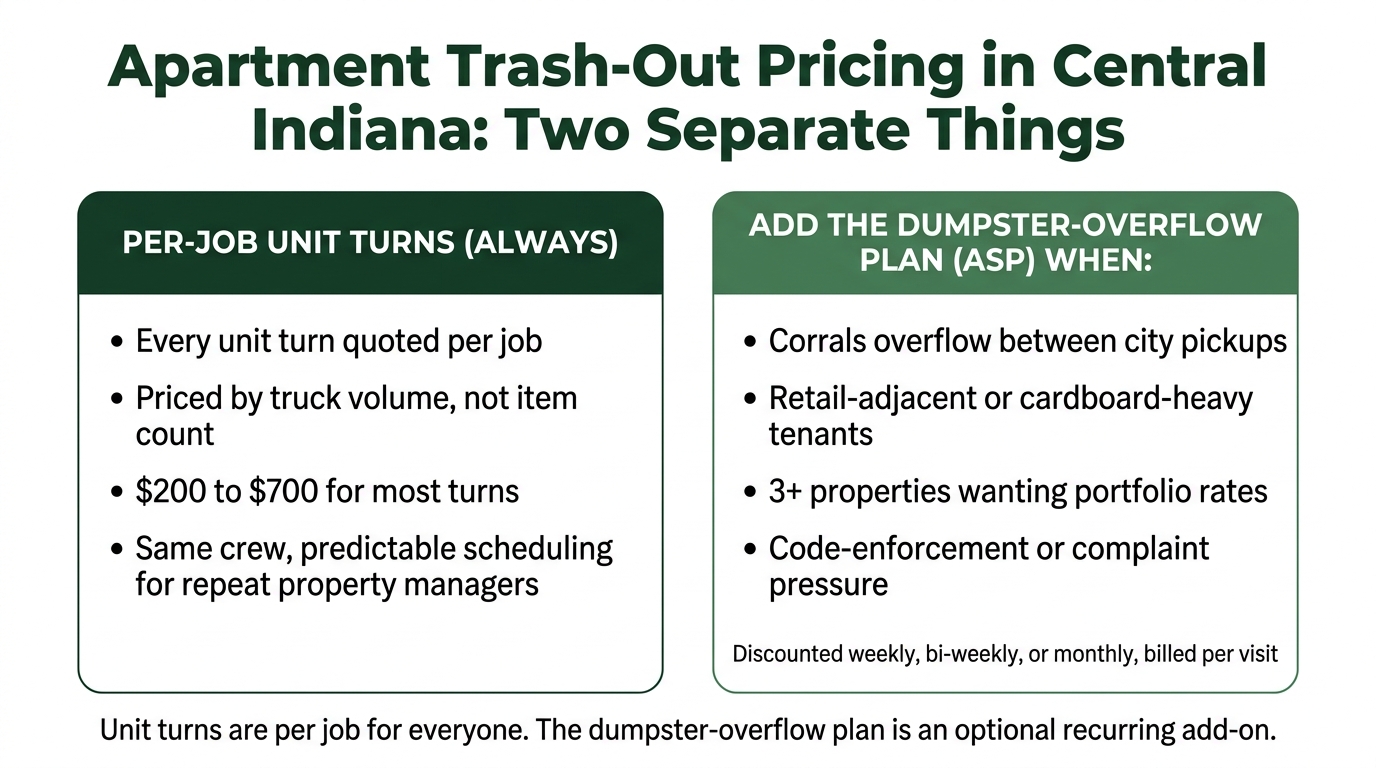
Per-unit move-out pricing (ad-hoc): you call when you need a turn. We quote the unit, schedule, do the work, invoice. Pricing reflects the full retail unit-turn rate ($200 to $700 depending on scope). You pay for the convenience of on-demand work but you’re paying the unpredictability premium.
Apartment Service Plan (ASP), our dumpster-overflow plan: a separate, optional service for properties whose dumpster areas overflow between municipal pickups. We run discounted weekly, bi-weekly, or monthly dumpster-overflow and common-area cleanup, billed per visit at a discounted recurring rate. ASP is not a unit-turn contract; unit turns are always quoted per job. The plan keeps your dumpster corrals and common areas clear so overflow does not drive tenant complaints or code violations.
Where the ASP dumpster-overflow plan saves the most money:
- Properties next to retail or with cardboard-heavy tenants. Dumpster areas that overflow every week or two are the core ASP use case.
- High-density complexes with chronic overflow. If your corrals fill before the municipal hauler returns, a standing weekly or bi-weekly visit is cheaper than one-off overflow calls.
- Multi-property portfolios. Managers running 3+ properties can negotiate overflow-plan rates at the portfolio level.
- Properties with code-enforcement pressure. Keeping common areas clear on a schedule beats reacting after a violation notice.
Unit turns themselves are always quoted per job, whether you book one a year or one a week. The dumpster-overflow plan simply sits alongside that per-job pricing for properties whose common areas need a standing schedule.
For context on broader central Indiana junk removal pricing, our general Indianapolis junk removal pricing guide walks through residential and retail pricing, and our central Indiana commercial cleanouts program covers the broader commercial scope beyond apartment-specific work.
What’s Actually Included in a Real Central Indiana Apartment Trash-Out Quote?
A real apartment trash-out quote should itemize at least five things, even if it’s bundled into a flat per-unit rate. When a quote shows up as just “$X per unit” with no breakdown, you’re going to get surprised on bedbug, freon, mattress, stairs, or special-item handling. Here’s what we put in every property-manager quote:
- Free walkthrough at the property. Before any pricing, we walk the property with the manager or maintenance lead, document typical unit-turn scope (number of bedrooms, average abandoned-furniture volume, recurring problem units), and identify any special-item patterns (bedbug rate, freon appliance frequency, mattress volume). Walkthroughs are scheduled around the property’s availability, not ours.
- Per-unit volume baseline. Standard apartment turn-out is priced by cubic yards (our 12 truck-volume price points) plus crew time. A real quote shows what a “typical” unit on your property looks like and what an “above-typical” unit triggers in pricing.
- Special-item surcharges itemized upfront. Mattresses ($35 surcharge for per-item transfer-station tip fees), TVs and electronics ($25 surcharge, mandated by Indiana e-waste law IC 13-20.5), refrigerant appliances (EPA Section 608 evacuation surcharge), tires (extra), paint or chemical residue (extra). A real quote lists every surcharge; a sloppy one surprises you on the invoice.
- Bedbug unit handling. Most competitors won’t take bedbug-affected units, which leaves property managers scrambling. We will, with appropriate PPE, sealed-bag protocol, and disposal routing that doesn’t recontaminate clean units. There’s a surcharge but it’s quoted upfront.
- Scheduling and response time. Standing property-management accounts get a defined response window (typically same-day to next-day during business hours). One-off calls get scheduled into available slots. A real quote spells out the SLA so you’re not surprised when a Friday-night call doesn’t get same-day response.
Our communication cadence (booking confirmation, two-day reminder, two-hour reminder, on-the-way text from the crew on the truck) was built specifically for property managers who need predictability around when haulers will actually arrive. The “when is someone going to show up” anxiety is the #1 complaint property managers have about national-chain haulers, and the dispatch cadence is the lever that fixes it.
How Do Central Indiana Property Managers and Landlords Get Billed for Apartment Trash-Outs?
Billing structure matters because property managers operating under multiple ownership entities or for management companies have different invoicing requirements than individual landlords. Here’s how we handle each:
Property management companies (multi-property): single master account invoiced monthly with per-property line items. Dumpster-overflow plan rates negotiated at portfolio level; unit turns billed per job. Net-30 terms standard. Suits any manager handling 3+ properties under one company.
Individual property managers (single complex): single account invoiced per call for turns, monthly for any dumpster-overflow plan. Net-15 or credit-card-on-file. Suits onsite managers handling one complex.
Individual landlords (small portfolios, 1-10 units): ad-hoc per-call billing typically, credit-card-on-file or per-invoice payment. Lower volume usually doesn’t warrant a standing overflow plan but we’ll quote either way.
HOAs and condo associations: billed to the association directly, typically per common-area cleanout or annual contract. Different scope from individual unit turn-outs.
Real estate investors / fix-and-flip operators: typically billed per property at closing or via investor’s preferred AP cycle. Some prefer combining cleanout + demolition into a single project quote.
If you’re invoicing through a management software platform (AppFolio, Yardi, Buildium), we can integrate invoice formatting to match your AP intake requirements. Just flag it during the walkthrough.
What Special Items Add Cost to Central Indiana Apartment Trash-Outs?
Property managers consistently underestimate how special-item volume drives quote variability. The six special-item categories that push apartment trash-out pricing above baseline:
Mattresses. Mattresses cost extra because transfer stations charge per-item tip fees. We pay those fees per mattress at Monroe County, Bartholomew County, and Indianapolis transfer stations and pass them through as a $35 surcharge per mattress on the invoice. Heavy mattress months (large lease-up cycles) can add $200-$500 to typical monthly billing.
Refrigerant appliances. Refrigerators, freezers, window AC units, dehumidifiers all contain refrigerant that legally must be evacuated by a certified technician per EPA Section 608 before haul-away. We handle the routing through certified processors but the surcharge runs $25-$60 per unit depending on size and type.
TVs and electronics. Indiana state law (IC 13-20.5) prohibits putting most electronics in regular trash. CRT TVs, flat-panel TVs, computer monitors, microwaves, small electronics all route through Indiana’s E-Cycle program. $25 surcharge per TV; smaller electronics typically bundled.
Tires. Some apartment tenants abandon tires (especially in extended-stay or multi-vehicle households). Indiana tire disposal carries a per-tire tip fee that gets passed through as $5-$15 per tire.
Bedbug units. Surcharge $100-$300 per affected unit depending on severity. Most competitors won’t touch these; the surcharge reflects the PPE + sealed-bag protocol + disposal routing required to avoid recontaminating other units.
Stairs. Upper-floor units without elevator access add labor time. Standard upcharge of $40-$80 per flight above the second floor.
Properties with chronic special-item volume (e.g., complexes with high senior tenant turnover often have heavier appliance and mattress patterns) usually benefit from scheduling turns ahead so surcharges are quoted upfront rather than surprising each invoice.
When Should an Indianapolis Property Add the Dumpster-Overflow Plan (ASP) on Top of Per-Unit Trash-Out Pricing?
Every property pays per job for unit turns. The question is whether you also need the recurring dumpster-overflow plan. The decision tree:
Add the ASP dumpster-overflow plan when:
- Your dumpster corrals or common areas overflow between municipal pickups
- You are next to retail or have cardboard-heavy, high-density tenants
- You manage 3+ properties and want portfolio-level overflow rates
- Code-enforcement or tenant complaints about overflow are a recurring problem
Stick with per-job pricing alone when:
- Your dumpsters stay ahead of the municipal pickup schedule
- Your only recurring need is unit turns, which are always quoted per job
- You are a smaller property or in transition (management change, sale pending)
Mixed approach: some of our central Indiana property managers run the dumpster-overflow plan at one or two high-traffic anchor properties and stay per-job everywhere else. The hybrid works when overflow pressure is uneven across the portfolio.
What Are Red Flags in Property-Manager-Targeted Indianapolis Apartment Trash-Out Quotes?
Property managers attract a specific type of low-bid hauler: someone who quotes aggressively low to land the contract, then upcharges on every special item. Watch for:
Cheap-quote red flags:
- No walkthrough offered before pricing. Apartment trash-out quotes cannot be accurate without seeing the property and understanding typical unit profile.
- Bundled flat rates with no special-item surcharge schedule. You’re going to get surprised on bedbug, freon, mattress, and TV invoicing.
- No insurance documentation provided at the levels apartment complexes require. We carry general liability and workers’ comp at the levels most apartment complexes require; many low-bidders don’t.
- “Same-day no questions asked” promises with no scheduling structure. Real property-management accounts have response-time commitments; same-day-everything haulers can’t sustain that without burning out the crew or skipping work.
- Refusal to handle bedbug units. Most competitors won’t, which leaves you holding units that can’t be turned. If a quote excludes bedbug work, find out what that means for your monthly turnover assumption.
Inflated-quote red flags:
- Annual contract pressure with cancellation penalties. Legitimate property-management relationships are month-to-month; pressure for 12-month locks usually means the operator can’t compete on per-call economics.
- Mandatory dumpster rental bundling. We don’t do dumpster rental and don’t bundle it; haulers who require it are upselling.
- Per-unit rates 2x+ above the market. Most central Indiana single-bedroom turns land $200-$400 by scope. A standard turn quoted far above that range indicates the operator is treating you like a one-off retail account.
- Disposal fees that exceed the labor line. Real apartment work has labor as the dominant cost; disposal fees over 30% of total quote suggest the operator is double-charging tip fees.
The Bottom Line: What to Budget Per Unit for Apartment Trash-Outs
For most central Indiana property managers planning 2026 apartment trash-out budgets, realistic numbers are: $200 to $700 per unit turn depending on scope and special items, $200 to $600 per visit for the recurring dumpster-overflow plan if your common areas need it, and $100 to $300 surcharge for bedbug-affected units (which we’ll handle, unlike most competitors).
We’ve been running apartment trash-outs across central Indiana since 2020, and the property managers who get the best economics are the ones who set up a hauler ahead of turnover season and add the dumpster-overflow plan only if their common areas need it. The ones who pay the most are the ones who call a different retail hauler cold for every turn. The convenience premium compounds.
If you’re managing an Indianapolis, Bloomington, or Columbus-area apartment complex and want a real per-unit quote, our team offers free walkthroughs at the property scheduled around your maintenance team’s availability. Two crews on the road, a skid steer for any property-level demolition work, insured with general liability and workers’ comp at the levels apartment complexes require, and a dumpster-overflow plan that flexes to your actual overflow volume, with unit turns always quoted per job and never locked into a 12-month contract. Book through the form above or call the office and we’ll get a walkthrough scheduled.