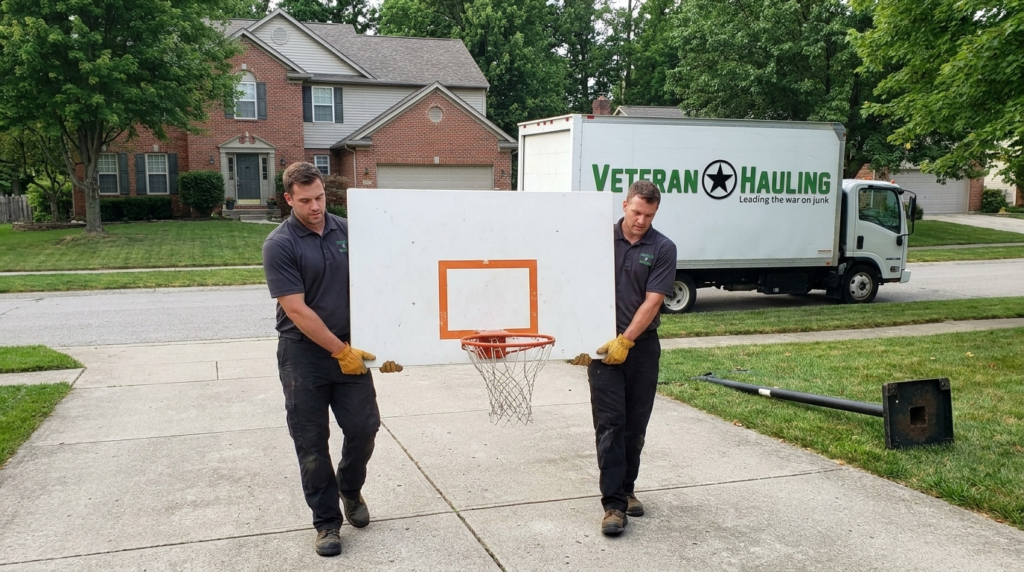
What it costs to remove a basketball hoop in Fishers comes down to one question: does the hoop stand on a base, or is it set in the ground? A portable hoop is one awkward item. An in-ground hoop is a steel pole and a backboard on top of a block of concrete, and the concrete is what pushes the price up. For junk removal in Fishers, Indiana, we quote on site from twelve price points, so none of the dollar figures below is our price.
Below, we walk through the gap between portable and in-ground hoops, cutting a pole versus digging out its footing, sand-filled bases, scrap value, and when doing the job yourself is the cheaper call.
Garage junk to clear in Fishers?
Veteran owned, and we serve Fishers. The crew sizes up the load on site and gives you the price there, with no obligation.
What Does Basketball Hoop Removal Cost in Fishers, Indiana in 2026?
Angi’s article on who to hire to remove a basketball hoop, updated July 8, 2026, put the job at $60 to $350 when we read it on October 3, 2026: around $60 for simple portable hoop hauling, and a few hundred dollars once the removal involves digging out concrete. Those figures describe the job in general. They are not a Fishers price, and they are not ours.
Fishers has a published number of its own. The City of Fishers’ trash services page, as we read it on October 3, 2026, says that for large or bulk items you contact Republic Services, the City’s contracted hauler, and pay $25 directly to Republic for the special pick-up. That contract covers homes inside Fishers city limits, not unincorporated areas outside them. Whether Republic will take a hoop is a separate question, covered below.
Three things move a hoop quote:
- The kind of hoop. A portable hoop stands on a plastic base. An in-ground hoop stands on a concrete footing.
- What fills the base. Water drains out. Sand and base gel do not come out easily, so they tend to leave with the base.
- What happens to the footing. Cutting the pole at the concrete is the short job. Digging the concrete out is the long one.
On our side, the crew sizes up the load on site and gives you the price there. No obligation, and you pay when the job is done.
Why Do Fishers Homeowners Pay More to Remove an In-Ground Hoop Than a Portable One?
Because an in-ground hoop is two jobs. Above the ground there is a steel pole, a backboard and a rim to take down. Below it sits the footing that holds them up, and it is bigger than the collar of concrete you can see at the edge of the driveway.
How much bigger depends on the maker. Goalrilla’s installation guide sizes the hole for its anchor system at 16 inches across and 48 inches deep, filled with eleven 80-pound bags of concrete, which comes to 880 pounds of dry mix. Lifetime’s guide to assembling its in-ground hoops calls for a round hole 18 to 24 inches across and 21 to 24 inches deep, with 420 to 640 pounds of concrete, both depending on the system. It adds that certain climate conditions, such as frost heave, can affect the required dimensions.
The part above ground is no light lift either. Goalrilla’s guide recommends, for safety, at least three capable people to help install one of its goals, and it describes the steel pole or backboard as weighing several hundred pounds. Taking a goal down moves the same glass and steel.
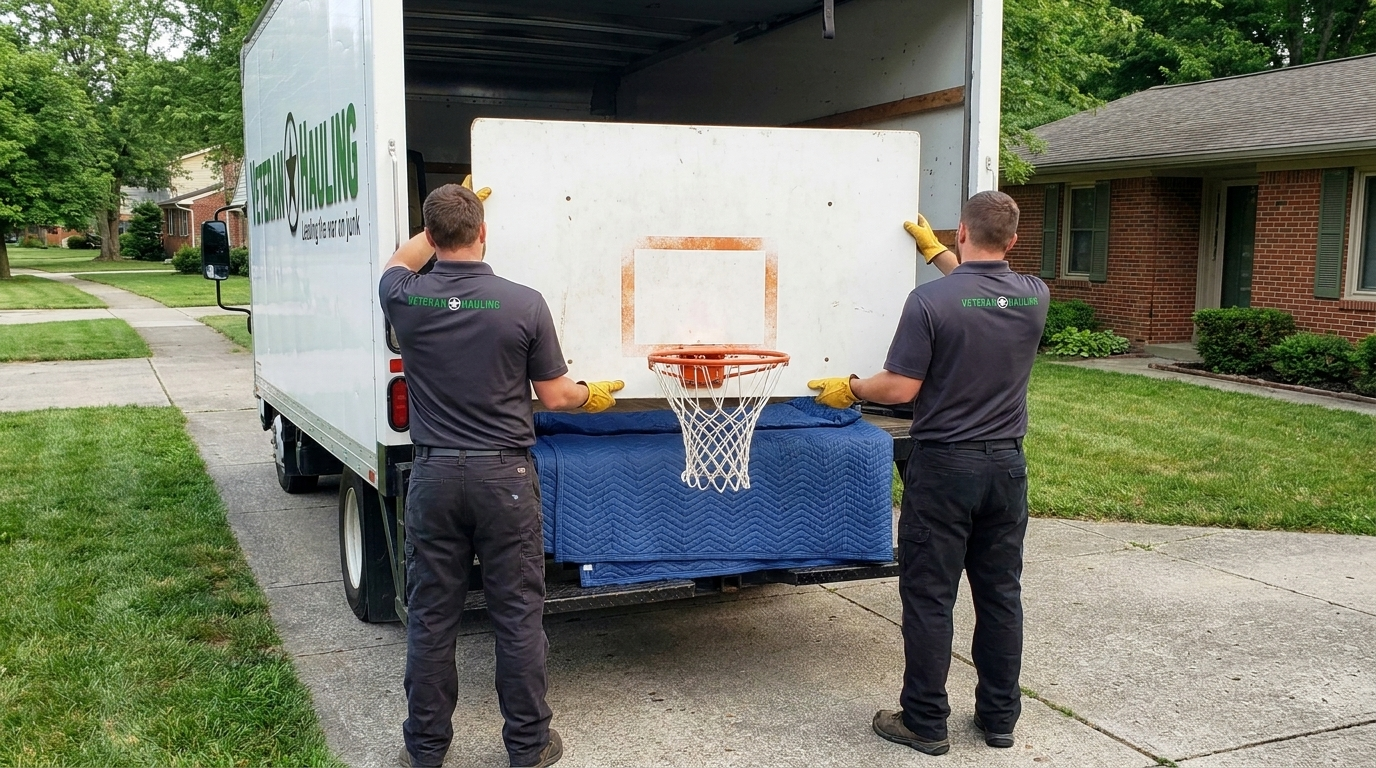
A portable hoop has no underground half: once its base is empty, it is one bulky item on wheels. That is the spread in Angi’s range: portable hauling sits at the bottom, and concrete digging sits at the top.
What Does It Cost to Dig Out a Hoop Footing Instead of Cutting the Pole Flush?
Cutting is the cheaper visit, and digging is the complete one. Angi’s guide calls cutting the pole where it enters the concrete a quick fix that leaves remnants behind, which hinder how the spot looks and what it can be used for. It calls digging the pole out the better long-term option: labor-intensive work that leaves nothing behind. That digging is what puts a removal at the top of Angi’s range instead of the bottom.
Some in-ground hoops need no cutting at all. Goalrilla says all of its in-ground goals are assembled on an anchor kit system that lets you relocate the goal, and Lifetime says an optional ground sleeve lets you move its in-ground hoop without breaking up the concrete. Either way, the anchor or sleeve stays in the footing. For a Goalrilla, the company’s article on moving its hoops says to follow the model’s installation manual in reverse and to find the model number on a sticker on the back of the pole; its product manuals page has the manuals for its Goalrilla, Goaliath and Silverback hoops.
A pole set straight into concrete is a harder cut than it looks. Owners in two Reddit threads, one on r/DIY and one on r/HomeMaintenance, found their poles filled with concrete inside. One person who filmed taking down an early-1980s hoop for YouTube found it “all cement and it’s pretty thick down there,” could not cut it with a blade, and planned to put the dirt back on top of the concrete left in the ground.
Which one to pay for depends on what comes next for that spot. If it is going back to lawn, cutting flush leaves the footing buried, which is cheaper today and still there later. If a new hoop is going in where the old one stood, the old footing is in the way unless the new goal fits its anchor. Goalrilla says its anchor kits and Silverback’s are not interchangeable, and that assembling a goal on the wrong anchor kit can seriously compromise the goal’s integrity and will void the warranty.
Digging a footing out means digging, so read the Indiana 811 section of our guide to fence removal costs in Indianapolis before anyone starts. If the hoop stands on a poured court or pad that is coming out too, that slab is its own job, and our shed removal cost guide covers what a concrete pad adds.
How Much Does Hauling a Sand-Filled Portable Hoop Base Cost in Fishers?
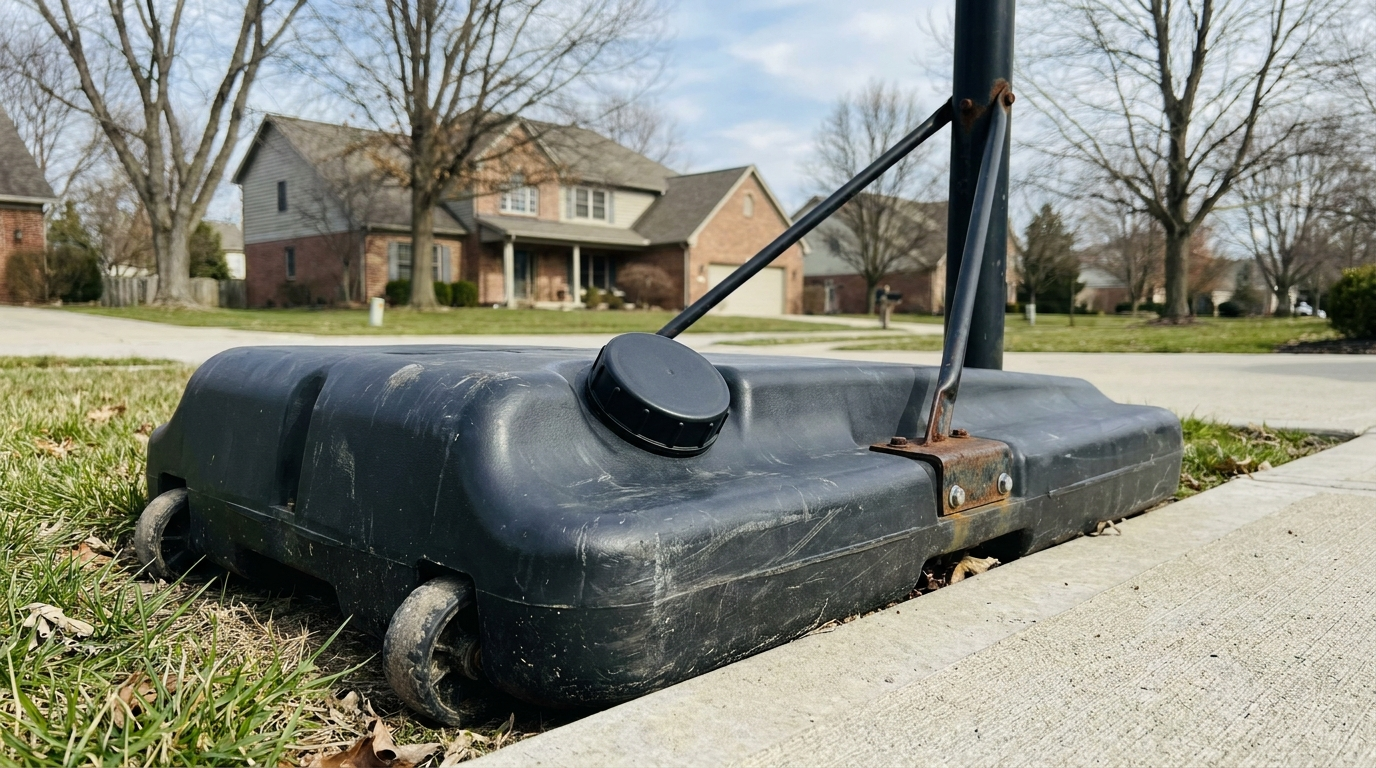
It can cost more than a base full of water, for one reason: water drains out, and sand does not come out easily. Dick’s Sporting Goods’ tips on filling a portable hoop say water is easy to empty from the base, that sand can be hard to add and is even harder to get out, and that base gel mixes with water to become solid.
Either way, the base is meant to be heavy. Spalding’s owner’s manual for one of its portable systems (manual M6611723) calls for about 34 gallons of water or about 300 pounds of sand, and it warns that the system may tip over if it stands upright without that weight, so it says not to leave the assembly unattended when the base is empty. We are not walking through draining here, because the steps belong to your model; its owner’s manual is the place to start.
Wet sand can be harder still. One owner on Reddit, trying to move a hoop with a sand-filled base, wrote that “the sand is wet and cannot be shop-vac nor will pour out.”
Inside Fishers city limits, the City-contract route for something too big for the cart is Republic’s bulk pickup. Republic’s collection procedures brochure for the City of Fishers, posted on the City’s website, says bulk pickups are by appointment with 48 hours’ notice and carry a prepaid charge of $25 per item, as we read it on October 3, 2026. It says items must be able to be safely lifted into the truck and that items too heavy will not be taken, and it lists sand among the unacceptable items.
Its definition of bulk items names furniture, wrapped mattresses and box springs, chairs, sofas, bound rolls of carpet and padding, and non-Freon appliances. A hoop is not on that list, so when you call Republic at 317-917-7300 to schedule, ask whether yours qualifies and whether the base has to be empty. A base still full of sand runs into both the weight rule and the sand rule.
Can Scrap Value From the Steel Pole Lower the Price of Hoop Removal for Fishers Families?
Probably not by much. Scrap dealers pay for metal, and not every part of a hoop is steel. Lifetime’s page on filling its portable bases says they are made of high-density polyethylene plastic, and Goalrilla’s guides describe its backboards as glass, so neither part goes to a scrap yard as steel. A pole filled with concrete, like the ones above, is not all steel by weight either.
Hamilton County’s recycling drop-off will not take the steel. The county’s General Recycling Area in Noblesville, which the county says is meant for Hamilton County residents who do not have curbside recycling, lists scrap metal among the materials it does not accept and points to two scrap metal dealers near the site. We found no published scrap price for a hoop pole; a scrap dealer is the one to ask whether it takes a single pole and what it pays.
For a hoop that still works, resale may pay better than scrap. In an r/ScrapMetal thread about the hoops collectors see at the curb, one commenter, asked whether hoops are worth much as scrap, said one was “possibly worth more to resell.” Another Fishers family with younger kids may want yours.
Junk sitting in a Fishers driveway?
Veteran owned, with same-day and next-day service. You get the price on site, and you pay when the job is done.
When Is It Cheaper to Remove a Hoop Yourself Than Pay a Fishers Crew?
When the hoop is portable, the base holds water, and you have somewhere for it to go: a sale, a giveaway, or Republic’s bulk pickup if Republic accepts it. Then the cost is your own time, plus $25 per item if Republic takes it.
An in-ground hoop changes the math. Goalrilla’s article on moving its hoops says the backboard has to lie flat in the vehicle, that its 60 by 38 inch and 72 by 42 inch backboards may not entirely fit and may be dangerous to transport in a flatbed pickup truck, and that renting a box truck or trailer is then the safer option. If the footing is coming out too, add the digging covered above and the call-before-you-dig step.
So doing it yourself tends to pay off for a portable hoop you can drain and carry, and for an in-ground hoop when you have the help and the vehicle and can leave the footing where it is. A glass backboard, a footing that has to come out, or no vehicle it fits in tips the math the other way.
On our side, we serve Fishers, with same-day and next-day service, and you get the price on site with no obligation. Here is how a visit to a Fishers home works. If a playset or a trampoline is coming out of the same yard, our swing set removal cost guide covers playset footings and adding a trampoline to the same visit.
The Recap
- Angi’s article, updated July 8, 2026, puts basketball hoop removal at $60 to $350, from around $60 for simple portable hauling to a few hundred dollars once concrete has to be dug out; those figures are Angi’s, not ours.
- An in-ground hoop costs more because of its footing, which is bigger than the collar you can see. Goalrilla sizes its anchor hole at 16 inches across and 48 inches deep. Lifetime’s in-ground holes run 18 to 24 inches across and 21 to 24 inches deep depending on the system, and Lifetime says certain climate conditions, such as frost heave, can affect those dimensions.
- Cutting the pole flush is the cheaper visit and leaves the footing buried. Digging it out costs more and clears the spot, which matters most when a new hoop is going in.
- A sand-filled base can cost more to haul than one full of water, because water drains out and sand and base gel do not come out easily. Inside Fishers city limits, Republic’s bulk pickup is $25 per item by appointment, but its bulk item list does not name hoops, and it turns away sand and items too heavy to lift, so call Republic first.
- Scrap value is unlikely to move the number much; we found no published scrap price for a hoop pole. Not every part of a hoop is steel, Hamilton County’s General Recycling Area does not take scrap metal, and a working hoop may do better resold or given away.
- Doing it yourself tends to pay off for a portable hoop you can drain and carry. A glass backboard, a footing that has to come out, or no vehicle it fits in changes that.