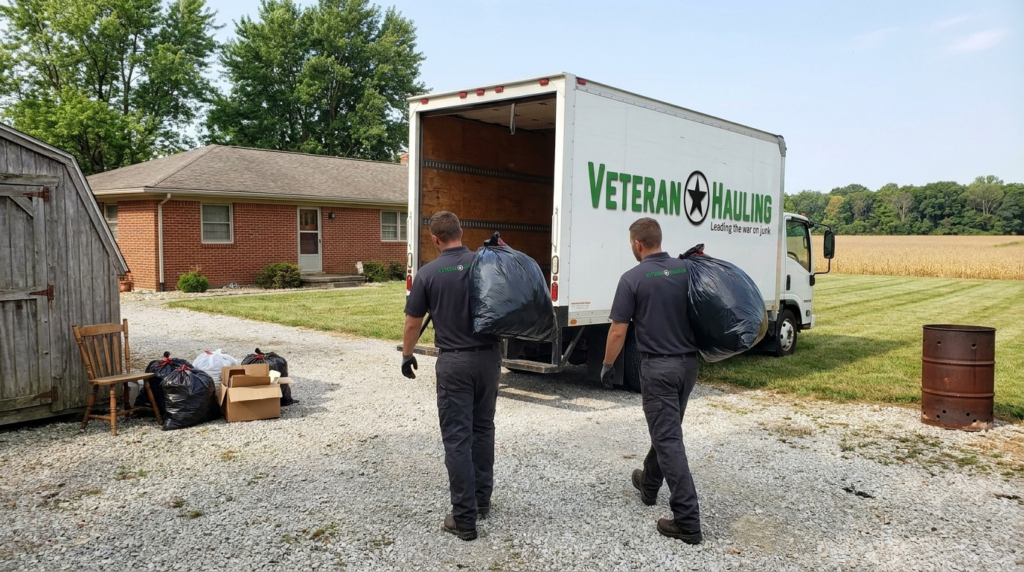
No. Burning household trash is illegal in Columbus, Indiana, inside city limits or out on a county road, on the ground or in a burn barrel. The Indiana Department of Environmental Management (IDEM) says so on its Burning Trash is Illegal page: it is illegal to burn waste materials, including household trash, business trash, construction and demolition debris, and dumped waste.
Below, we cover the few legal fires, what changes at the city line, burn bans, neighbor complaints and where the trash can go instead. It is a plain-English reading of the rules as published on October 2, 2026, not legal advice. If a pile grew because burning was the plan, our crew handles junk removal in Columbus, Indiana.
Junk you can't legally burn in Columbus?
Veteran owned. We run out of Columbus and cover the I-65 corridor, and the crew sizes up the load on site and gives you the price there, with no obligation.
Is Burning Household Trash Legal Anywhere in Columbus, Indiana?
No. Indiana’s open burning rule sets the ban in one line, 326 IAC 4-1-2: “Open burning is prohibited except as allowed in this rule.” The exemptions that follow run from campfires and heating fires to fire department training, and none of them names household trash.
The rule applies statewide, so a Columbus subdivision lot and a farmhouse at the end of a county road get the same answer. Inside city limits, Columbus Municipal Code 8.24.040 adds its own ban: “No burning of refuse shall be allowed in the city except in incinerators approved by the Indiana Department of Environmental Management.” We quoted that clause in our guide to handling illegal dumping on a Columbus property.
So the answer does not depend on your address. The address changes the rest: which local rules govern a legal fire, who answers a complaint, and who hauls the trash instead.
What Can You Legally Burn in a Backyard Fire Under Indiana Rules?
Of the exemptions in 326 IAC 4-1-3, two cover the fires most homeowners mean, and both are narrow.
The first is a recreational or cooking fire, such as a campfire. Subsection (c)(1) limits it to clean wood products, paper, charcoal and clean petroleum products, never for disposal, under conditions IDEM lists in full on its exempt burning activities page.
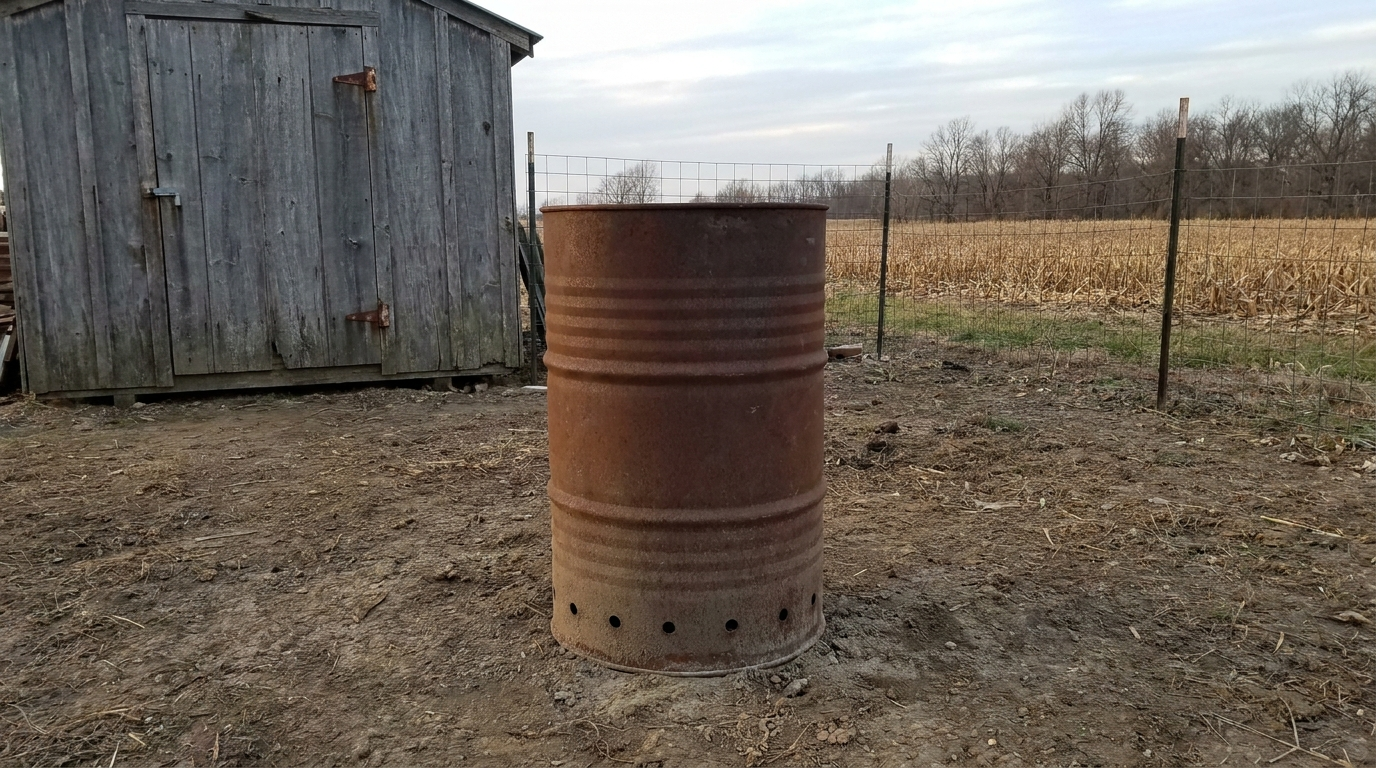
The second is private residential burning, the kind IDEM’s summary ties to a burn barrel. Subsection (c)(2) allows it only where the building has four or fewer dwelling units, never in apartment or condominium complexes or mobile home parks, and not in the four counties listed in 326 IAC 4-1-4.1(c): Clark, Floyd, Lake and Porter. Bartholomew County is not one of them. Where it is allowed, all of these conditions apply:
- Only clean wood products and paper may be burned.
- The fire goes in a noncombustible container with enclosed sides and a bottom, sufficiently vented to induce adequate primary combustion.
- Adequate firefighting equipment is on site during burning.
- Someone attends the fire at all times until it is completely out.
- Burning is in daylight only, and the fire is out before sunset.
- No burning in high winds, temperature inversions or stagnant air, or when a pollution alert or air quality action day has been declared.
- The fire is put out if at any time it creates a pollution problem, a threat to public health, a nuisance or a fire hazard.
- The burning complies with every other federal, state and local law, rule and ordinance.
Local rules enter through that last line. The Columbus Fire Department’s page on open burning inside city limits adds its own requirements, including a flat ban on open burning of trash.
Why Doesn’t the Clean Wood Exemption Cover Trash in a Columbus Burn Barrel?
Because the exemption is about what goes into the fire, not what holds it. The barrel is a condition. The permission is the material: clean wood products and paper, nothing else.
Even wood has a test. The rule’s definitions section, 326 IAC 4-1-0.5, counts a wood product as clean only when it is not coated with stain, paint, glue or other coating material, which leaves out a painted picket or a stained deck board. Household trash fails outright: a kitchen bag holds plastic film, foam trays, coated cartons, cans and food scraps. IDEM’s page names the barrel itself: under “Do not,” its first line is “Place trash in a barrel or on the ground and set it on fire.”
A campfire is no workaround either, because it “shall not be used for disposal purposes.” The barrel belief still shows up. A Reddit user in Indiana wrote on r/neighborsfromhell in February 2025 that an officer said nothing could be done if the burning was in a burn barrel. That is one poster’s account of one conversation, and the state rule says otherwise.
Do Burning Rules Change Once You Live Outside Columbus, in Rural Bartholomew County?
Not for trash. The state ban covers a farm as it covers a city lot, and IDEM’s summary of the separate farm and maintenance exemptions says never to burn regulated solid waste, including household trash, painted or treated wood, or waste tires.
What changes at the city line is the local layer. Past it, the outdoor burning rules in Chapter 91 of the Bartholomew County Code of Ordinances take over from city code, but section 91.35 limits them to “residential developments in the unincorporated areas of the county,” which section 91.36 defines as two or more adjoining residential parcels, none over three acres, plus apartment complexes and mobile home parks. A lone parcel outside that definition is outside the county’s outdoor burning rules but still inside the state rule.
The trap is section 91.38, which the county’s online code dates to a July 1985 ordinance and which still lists, among the fires it permits, “the burning of residential refuse and trash, all of which must be completely combustible, in a noncombustible container with enclosed sides, a bottom and a mesh covering with openings no larger than one-quarter inch square.” It reads like permission, and it is not.
The state rule’s exemptions do not include a county ordinance, and IDEM’s laws and rules page says residents must comply with city and county restrictions in addition to the state rules. Columbus Township Fire & Rescue, which serves Columbus Township, puts it plainly on its open burning laws page: the local government abides by all of the state regulations, and household trash is on its list of what you may not burn.
A newcomer can hear the opposite. A 2011 BackYardChickens forum thread titled “Burning trash?” opens with a poster moving to the country with no trash pickup, whose landlord’s answer was the burn barrel. That poster’s profile lists central Ohio, and a landlord’s habit is not a rule: in Bartholomew County that barrel is still no answer for trash.
How Do You Check for a Burn Ban Before Lighting a Fire Near Columbus?
A burn ban can stop even a legal fire. It adds limits on top of everything above and lifts none of them.
The Indiana Department of Homeland Security’s page on issuing burn bans says any local fire chief can order a ban for that chief’s jurisdiction, or the legislative body of a city, town or county can impose one, and that the issuer decides what is restricted, who enforces it and how long it lasts. In Bartholomew County, Columbus Township Fire & Rescue says bans are typically issued by the County Commissioners with support from local fire chiefs, and sometimes by individual fire chiefs for their own jurisdictions.
- Check the Indiana Department of Homeland Security’s Burn Ban Map for Bartholomew County. It shows each county’s status with the most recent time the county provided it, so read both.
- Check the air. 326 IAC 4-1-3 bars the fires it allows when a pollution alert or air quality action day has been declared, and IDEM’s SmogWatch page takes sign-ups for Air Quality Action Alerts.
Junk to clear from rural land near Columbus?
Veteran owned. We travel up to about an hour and three quarters from the yard, and the price comes on site, with no obligation.
What Happens When a Columbus Neighbor Reports You for Burning Trash?
IDEM’s Burning Trash is Illegal page sends complaints two ways: to the local fire or health department when someone’s burning is a nuisance or a threat to health or property, and to IDEM’s complaint coordinator to report illegal open burning. In Bartholomew County, the County Health Department lists open burning among the complaints its environmental health staff investigate.
On the fire side, a complaint can end even a legal fire. Columbus Township Fire & Rescue’s page says that if smoke from lawfully burned natural wood drifts into a neighbor’s home through an open window and they complain, you must stop burning immediately.
The state side runs on a longer clock. IDEM’s complaint page, as we read it on October 2, 2026, lists open burning of trash among the complaints its inspectors investigate and sets a goal of responding within 30 days and addressing each complaint within 90 days. The page says a complaint can be filed without a name, though anything submitted can become public record.
Why Is Burning Trash on a Columbus Property Worse Than It Looks?
A barrel fire looks small. IDEM’s health risks page says trash smoke is especially toxic because of the synthetic chemicals in coated papers, plastics and other materials people commonly throw away, and that it may contain dioxins, arsenic, mercury, chromium, PCBs and lead, among other air pollutants found to be carcinogenic. The same page says those pollutants travel on the wind, settle in lakes, streams and soil, and seep into ground water, and that people with existing health conditions, the elderly and young children are especially vulnerable to smoke.
There is a legal catch, too. Under 326 IAC 4-1-5, a person who lets combustible material pile up may not escape liability under the rule for a fire it feeds that causes air pollution by saying vandals set it, it was an accident or it was an act of God. A heap of trash waiting for the barrel is your problem even if someone else lights it.
What Should Columbus Homeowners Do With Trash They Can’t Legally Burn?
Get it collected or hauled. IDEM’s recommended alternatives for trash include recycling what you can, using a municipal or private trash service and taking the rest to a permitted facility. Around Columbus:
- Inside city limits: buying a City of Columbus toter buys the collection service, and the Department of Public Works’ Toter Information page says each household gets one trash toter with no monthly charge, with fees only for a size change or an extra toter. For what will not fit, see what Columbus bulk pickup will and won’t take.
- Outside city limits: the Bartholomew County Solid Waste Management District (BCSWMD) keeps a list of local waste haulers that county residents without City Sanitation service can sign up with. Its convenience stations page, as we read it on October 2, 2026, says county residents can drop up to 200 pounds of bagged trash, a level pickup truck bed or less, at the Harrison and Petersville Township stations on Saturdays from 8 a.m. to 3 p.m., outside the holiday closures it lists, and that the stations refuse items including electronics, large or bulky items and burn barrels.
- Bigger loads: see our guide to the Bartholomew County Landfill’s hours and rules.
When the problem is a pile that built up while burning was the plan, that is junk removal work. We run out of Columbus and travel up to about an hour and three quarters from the yard. The crew sizes up the load on site and gives you the price there. No obligation, and you pay when the job is done. You can book a crew for your Columbus property through our local page.
The Bottom Line in Plain Terms
- Burning household trash is illegal across Indiana, in a barrel or on the ground, and Columbus Municipal Code 8.24.040 bans burning refuse in the city except in IDEM-approved incinerators.
- The backyard exemptions are narrow: a recreational or cooking fire, never for disposal, or residential burning of clean wood products and paper in a vented noncombustible container, under the conditions above.
- Chapter 91 of the county code still lists trash in a screened container, but residents must follow local rules in addition to the state rule, whose exemptions do not include household trash.
- Check the Burn Ban Map and IDEM’s air quality alerts before any legal fire.
- Smoke complaints go to the fire or health department, and illegal burning to IDEM.
- Instead of burning, use a City trash toter, a private hauler or a BCSWMD convenience station, and a junk removal crew for the pile.