
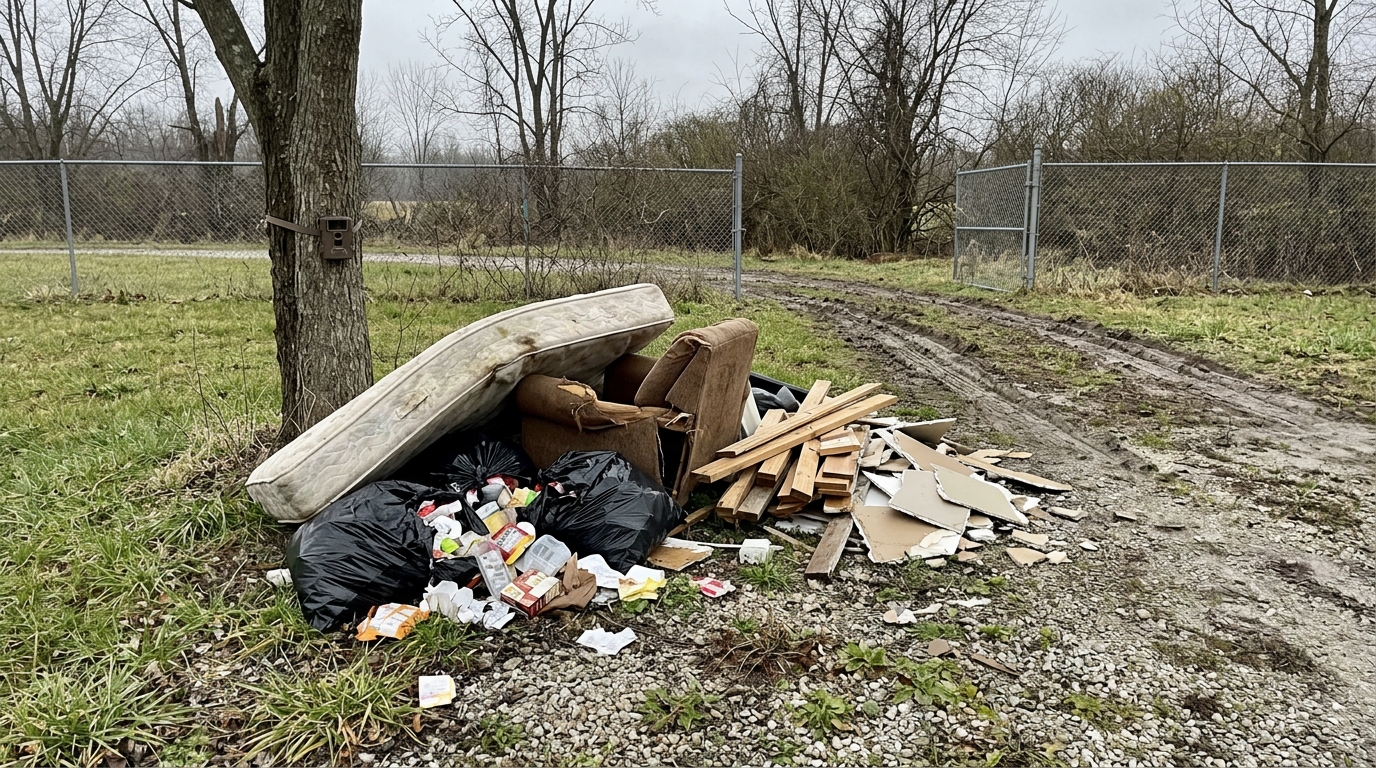
Someone backed up to the edge of your lot overnight and left a pile. Mattresses, a couch, bags of household trash, maybe a stack of shingles off a roofing job. You did not put it there and did not agree to it.
Here is the part most people find out late: reporting it and clearing it are two separate obligations, and the second usually lands on the landowner. That is why we get called for these, and why they run through our property management junk removal work more often than any other surprise job.
Below is what the rules in Columbus and Indiana say, who to call, what you must not touch, and when a pile needs a crew. We are a junk removal company and not a law firm, so treat this as a plain-English starting point rather than legal advice, and take anything with money or liability attached to your own attorney.
Dumped pile on your Columbus property?
Veteran-owned with a 5.0 rating across about 600 Google reviews, we clear dumped piles and bring the skid steer when the pile needs one, free on-site quote.
Who Has to Clear Illegally Dumped Trash on a Columbus Property?
Almost always the property owner, even though the owner did nothing wrong.
Two rules sit on top of each other here. At the state level, Indiana’s rule on open dumps, 329 IAC 10-4-4, makes the owner of real estate on which an open dump is located responsible for correcting and controlling any nuisance conditions it causes, and says that correction must include removal of all the solid waste from the area of the open dump and its disposal at a permitted facility, or another method the commissioner approves. The duty attaches to the land, not to whoever left the pile.
Inside Columbus city limits there is a second, faster layer. Columbus Municipal Code 8.24.280(B) prohibits depositing solid waste on public or private property without the property owner’s consent, and 8.24.280(F) sets out what happens next: the city services manager issues a twenty-four hour written notice to resolve the situation, and per that same subsection the notice goes to both the property owner and the responsible party. If the condition still exists at the end of that period, the sanitation department may rectify it and bill a clean-up fee.
One nuance worth having, because it changes how much time you may have. The city’s own chapter routes waste accumulating along the right of way to that twenty-four hour process under 8.24.280(F), while under 8.24.100(C) waste accumulating on the property but away from the right of way follows a slower administrative track that includes a hearing. So the twenty-four hour clock is real, and it is not the only route. Do not assume you have a month, and do not assume you have a day.
What Should You Do Before You Remove an Illegal Dump Pile in Columbus?
Document it before you touch it. Ten minutes here is worth more than anything else in this guide.
Photograph the pile where it sits, from several angles, wide enough to show where it is on your property and close enough to show what is in it. Include something for scale.
Note the date and time you found it, and when you last know the spot was clear. That window is what any enforcement or insurance conversation will turn on.
Look for identifying material without digging through it. Dumped piles routinely carry mail, prescription labels, invoices, delivery boxes and contractor debris with a company name on it. If the responsible party can be determined, the ordinance sends notice to them as well as to you, so a name on an envelope changes the picture.
Check for anything hazardous from a distance before anyone starts lifting. Sharps, drums, unlabeled containers and anything leaking are reasons to stop and call rather than load.
Do not burn it. Columbus Municipal Code 8.24.040 allows no burning of refuse in the city except in incinerators approved by the Indiana Department of Environmental Management. A burn pile turns someone else’s dumping into your violation.
How Do You Report Illegal Dumping in Columbus Before You Haul It Away?
Report first, clear second. Once the pile is gone there is nothing to document.
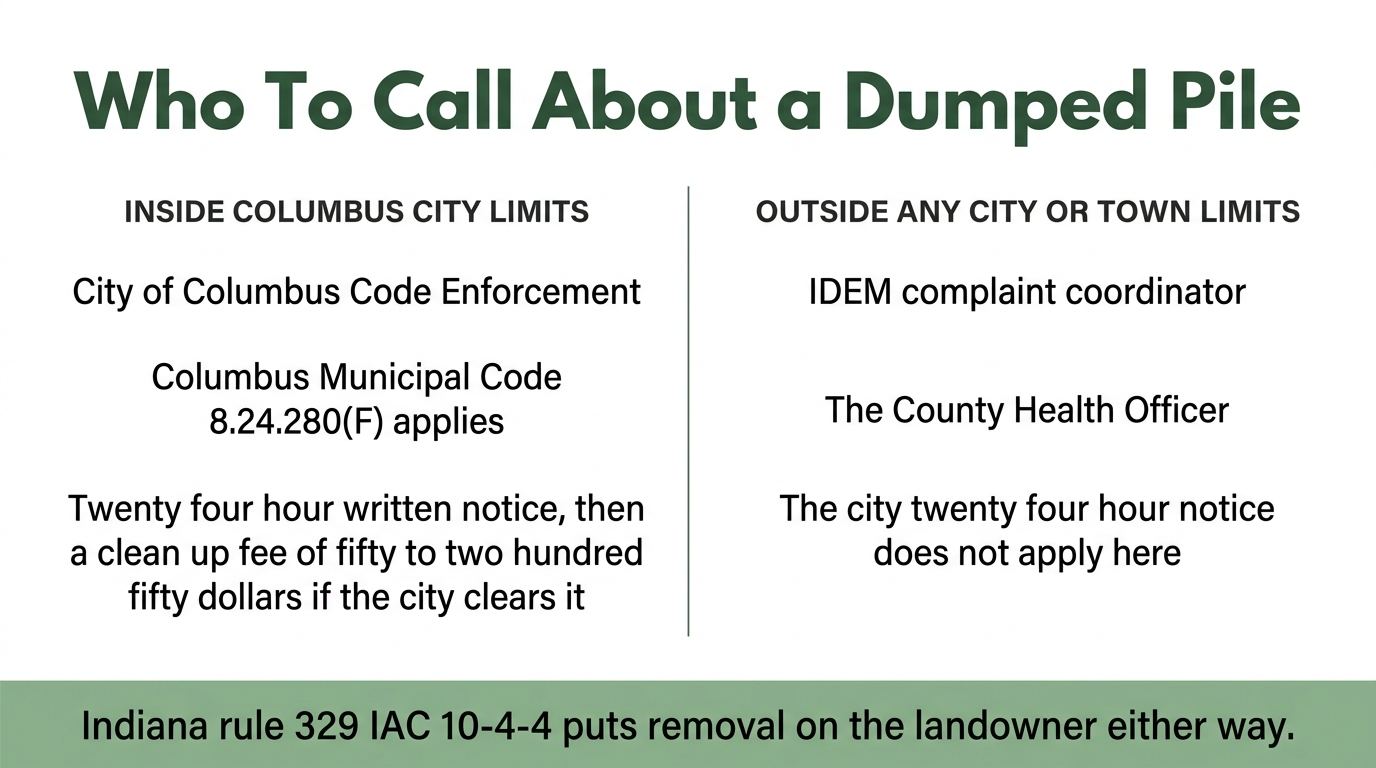
Inside Columbus city limits, the route is City of Columbus Code Enforcement, which lists garbage and rubbish among the categories it handles. It is at 123 Washington Street, reachable on (812) 376-2500 or at codeenforcement@columbus.in.gov.
Anywhere in Indiana, including unincorporated Bartholomew County, the route is the Indiana Department of Environmental Management’s complaint process, and IDEM publishes background on what counts as open dumping and how it is handled.
Be aware of one thing that trips people up: Columbus does not run a dedicated illegal-dumping web form the way Indianapolis does. You are making a phone call or sending an email, not filling in a portal, so keep your own record of when you reported it and to whom.
And know which side of the line your property is on before you call. Chapter 8.24 binds inside the city. A rural parcel outside the corporate limits of any city or town is county ground, where the County Health Officer and IDEM are the route and the city’s twenty-four hour notice does not apply. Guessing wrong wastes a week.
Which Illegally Dumped Debris Can a Columbus Landowner Not Dispose Of?
A dumped pile is rarely one clean category, and the parts are not all yours to move.
The city is explicit about several of them. Per Columbus Municipal Code 8.24.160, hazardous waste is not to go in a city container with other solid waste and will not be disposed of by city services. Per 8.24.190, motor oil is not collected and the generator is responsible for taking it to a reclamation center. Per 8.24.200, paint may go in a city container only once it has dried to a solid state and the lids are off. Per 8.24.150, tires are not collected by city services and should go to a tire recycling center.
We should be plain about our own limits, because they line up with that list. We do not haul paint, chemicals, fuel, oil or hazardous materials, and we do not take tires out of a dumped pile as part of this work. Those route to the county household hazardous waste stream and to a tire recycler. Our guide to the hazardous waste drop-off schedule covers where that material goes, and the city’s refusal to collect tires at the curb is covered in our Columbus bulk pickup rules.
So the working method on a mixed pile is to sort it rather than to move it. The gated fraction goes to the routes above. Furniture, mattresses, bagged household trash, construction debris and scrap come out with us.
Who Pays to Clear a Dumped Debris Pile on Columbus Land?
If the person who dumped it is never identified, the landowner pays.
The ordinance is direct about the mechanism. Per Columbus Municipal Code 8.24.280(F), if the condition still exists after the twenty-four hour notice period the sanitation department may rectify it, and the clean-up fee that follows is a reimbursement of the manpower and equipment used, which that subsection sets at no less than fifty dollars and no more than two hundred fifty dollars. Per the same subsection, failing to pay within ten days results in an ordinance violation filed by the city attorney, the fine for which is fifty dollars plus the cost of clean-up, and each subsequent violation within a twelve-month period increases the fine in fifty dollar increments plus clean-up costs, court costs and reasonable attorney fees.
Read that as a floor rather than a bill. Those figures are the city’s charge for stepping in, not the cost of a real cleanout, and a pile large enough to need a machine is a different number entirely. The reason most owners clear it themselves is control: you choose the contractor, the timing and the method, rather than receiving an invoice for work already done.
Whether any of this is recoverable from an identified dumper, or from your insurer, is a question for your attorney and your policy rather than for us.
Managing property in Bartholomew County?
Veteran-owned crews clear dumped piles from shared lots and alleys on a recurring schedule, 5.0 rating across about 600 Google reviews, free on-site walkthrough.
How Do You Stop Repeat Dumping After You Clear a Columbus Lot?
Clearing it fast is the most effective deterrent, and the one most owners delay.
A cleared site reads as watched. A pile that sits reads as permission, and the second load usually arrives faster than the first did. Beyond speed, the measures that hold up are physical and boring.
Block the approach. Most dumping happens where a vehicle can back in unobserved. A gate, a cable, a line of boulders or a berm across the obvious pull-in does more than any sign.
Light it. Dumping is a night activity. A motion light on the approach changes the calculation.
Put a camera on the approach rather than on the pile. You want the vehicle and the plate, which means covering where it stops, not where the load lands. A game camera on a tree is cheap and works.
Sign it, but do not rely on it. A no-dumping sign helps establish that access was not consented to. It does not deter anyone on its own.
Keep the edges maintained. Mown verges and clear sightlines make a parcel look attended. Overgrowth is an invitation.
How Do Columbus Property Managers Clear Dumping From Shared Lots?
For a managed property this stops being an incident and becomes a line item, and is worth treating that way.
Shared rear alleys, parking lots behind a row of units and the area around a trash enclosure are the three places it recurs. The enclosure is the worst of them, because a container on site reads as an invitation to add to it, and the material left beside it is usually the material the container will not take: mattresses, furniture, construction debris.
What works is a standing arrangement rather than a call each time. Assign one person to photograph and log each occurrence, because a pattern across months is what supports a case for a gate, a camera or a change to the enclosure. Keep a scheduled clearing cadence so nothing sits long enough to attract a second load. And keep the tenant conversation separate from the dumping conversation, because material left behind by a departing tenant is a different problem with different rules, which we cover in our guide for Indiana property owners handling abandoned property.
When Does an Illegal Dump Pile on Columbus Land Need a Crew to Haul It?
A few bags in a pickup is a Saturday. Past that, three things push a pile into crew and machine territory.
Volume and weight. Dumped construction debris, shingles, concrete and soil are heavy rather than bulky, and they load slowly by hand. We own our skid steer, which is what makes a spread-out pile on soft ground a half-day rather than a week, and heavier teardown work runs through our demolition crews.
Ground conditions. Piles get left where vehicles can reach, which is often a field edge, a ditch line or a gravel apron. Loading off uneven or wet ground is where people get hurt.
Mixed and unknown material. If you cannot see what is in it, do not sort it by hand. A crew that does this weekly knows what to set aside and what to route elsewhere.
We price by volume in the truck and quote on site after seeing the pile, which matters more here than on a normal job because nobody knows what is under the top layer until someone looks. Our crews work across Columbus and Bartholomew County.
The Bottom Line on Illegal Dumping Cleanup in Columbus
The hard truth is that the duty follows the land. Indiana’s open dump rule puts removal on the owner of the real estate, and inside Columbus the city has a twenty-four hour notice mechanism and a clean-up fee it can bill you if it steps in.
So do it in order. Photograph the pile before anyone touches it and note when you found it. Report it, to Columbus Code Enforcement if you are inside city limits and to IDEM if you are anywhere else in Indiana, and keep your own record of the call. Sort out the paint, chemicals, oil and tires, because those have their own routes and are not ours to take. Then clear the rest without delay, because a cleared site does not get a second load nearly as often as a waiting one.
We are veteran-owned, founded in 2020, insured with general liability and workers’ compensation, and we hold a 5.0 rating across about 600 Google reviews. We own our skid steer, we quote on site after seeing the pile, and the estimate is free with no obligation. None of the above is legal advice, and a dispute over who pays belongs with your attorney.