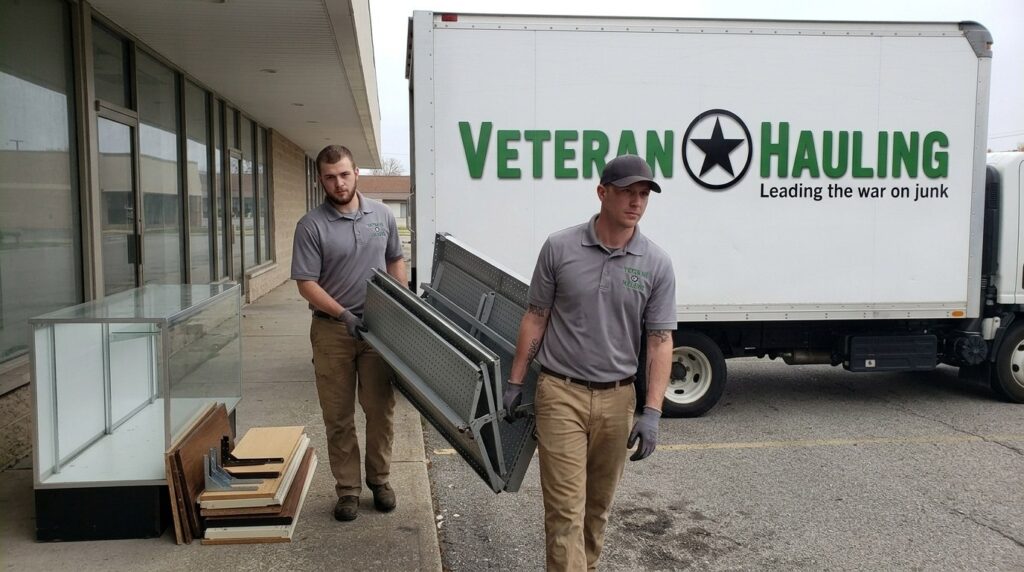
Fixtures are the reason retail cleanouts get budgeted wrong. A store owner looks at forty feet of gondola shelving, two glass display cases and a checkout counter, and sees money. That instinct is not wrong. Those things have a real secondary market.
The problem is that the market runs on its own schedule and a lease does not. Fixtures sell for something over months, and for little in a week. A closing store has a move-out date, which is why the honest question is never what your fixtures are worth. It is what they are worth by the day you hand back the keys. That gap is most of what we get called about for retail store cleanouts across Columbus.
Here is what drives the price of a Columbus store cleanout, what the fixtures are realistically worth against your deadline, and where the surprise fees come from.
Closing a store in Columbus?
Veteran-owned with a 5.0 rating across about 600 Google reviews, we work to your move-out date and quote free on site before anything is loaded.
What Does a Retail Store Cleanout Cost in Columbus, Indiana in 2026?
It is priced by how much space your load takes up in the truck, not by how many items you have or how many square feet the store is.
We price by truck volume across twelve price points, and every commercial client gets a free estimate before we start loading. The practical effect is that two stores of the same floor area can price differently: one with tall gondola runs and a stockroom full of leftover inventory fills more truck than one with a few racks and bare walls. The general volume breakdown sits in our central Indiana junk removal pricing guide.
One thing that separates a store from most commercial cleanouts is what does not have to happen first. Most retail store cleanouts wrap up in a single visit. Nothing in a typical storefront has to be de-energized by a specialist, drained, or certified before a crew can start, so the schedule is a labor question rather than a queue of other trades. For larger spaces we bring extra crew and trucks rather than stretching the job across days.
You will see national figures quoted for this online. We are not going to repeat them, because they come from operators in other markets pricing other buildings, and publishing them as Columbus numbers would be inventing a local rate we did not measure.
Why Do Columbus Store Fixtures Cost More to Strip Out Than Office Furniture?
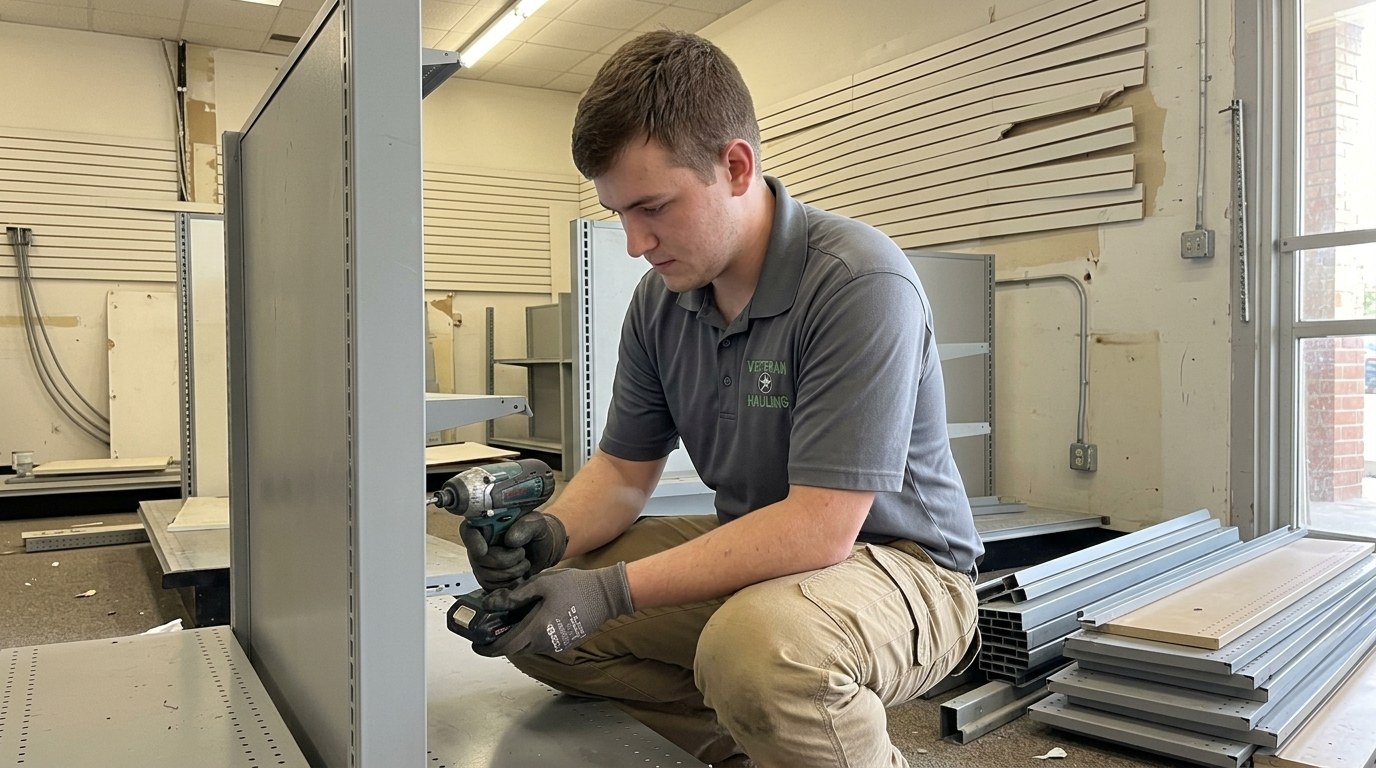
The difference is not weight, it is how the thing was installed. A store was fitted out to look finished, so most of what you are looking at was assembled in place against a wall or a slab, and taking it apart is the reverse of that build.
A desk unbolts from itself. A gondola run is a continuous system: uprights anchored into the floor or tied back to the wall, base decks, brackets and shelves that have to come off in order before the frames will move. Slatwall and pegboard are screwed through to studs and usually take a strip of drywall with them. Wall standards, millwork counters and built-in dressing rooms were fitted to the room after the walls went up. Checkout counters are frequently anchored and wired for a register drop.
None of that needs a specialist trade the way a kitchen does. It needs hands, time and the right tools, which is why our crews bring the tools to disconnect and haul out shelving, display cases, wall-mounted fixtures and anything else bolted down inside the space.
The comparison people usually reach for is an office, and the cost drivers there are genuinely different. We break those down in our office cleanout cost guide.
What Do Columbus Crews Quote to Pull Store Shelving and Display Cases?
Shelving and cases are quoted together with everything else, on a walkthrough, because the two variables that matter are not visible from a photo.
The first is how the fixture is attached. A free-standing rack that lifts out is quick. The same rack lagged into a concrete slab is a different job, and a wall-mounted system that has to come off in sequence is different again.
The second is what the fixture is made of and how it breaks down. Glass display cases have to be handled as glass, which means they take space and care rather than muscle. Gondola shelving flat-packs efficiently once it is apart, so a long run takes less truck than its assembled footprint suggests. Solid millwork counters do not break down at all and travel as bulk.
That is why a walkthrough beats a phone estimate here. It is free and it takes a few minutes, and it is the only way to see whether your forty feet of shelving is a two-hour job or an afternoon.
How Does Leftover Columbus Store Inventory Change the Cleanout Price?
Inventory is the variable most closing stores underestimate, because it is priced by volume like everything else and it is bulkier than it feels.
Unsold stock, packaging, fixtures’ worth of hangers, signage, seasonal displays and the contents of a stockroom all take truck space. A rail of clothing that looks like nothing occupies more cubic feet than the rail it hangs on. Boxed stock stacks efficiently; loose stock does not.
Three things reduce that volume before we arrive, and all of them are worth doing. Run the closing sale further down than feels comfortable, because unsold stock costs you twice, once as lost margin and again as volume in the truck. Donate what is usable rather than hauling it. And break down and flatten packaging, which is the single cheapest volume reduction available to you.
What is left is a legitimate part of the load and we take it with the fixtures in the same visit.
Which Columbus Retail Fixtures Are Worth Reselling Before You Pay to Haul Them?
Some of them are worth real money, and the honest framing is that resale value and your deadline pull against each other.
Gondola shelving is the clearest case. It is largely standard and interchangeable between makes, which is what makes it useful and also what floods the market. As one commenter who has done display work across chain stores put it, there are many larger chains closing and not many businesses can use this shelving, or need anywhere near as much of it as is being got rid of. Glass display cases, checkout counters, mannequins and lighting have thinner but real markets.
The timing problem is best shown by what happened to one closing store, described by the buyer on a small business forum. Two weeks before closing it was asking eighty dollars for a nine foot run of shelving and two hundred and fifteen for a twenty-seven foot run, and the buyer thought that was high and waited. He called back the day before the doors shut and the store had not sold any of it. He negotiated one run down, and ten minutes later the manager offered him the entire remaining stock, roughly two hundred and twenty feet, for one hundred and twenty five dollars, on the condition it was gone the next day. The buyer reckoned he had taken about eight thousand dollars of shelving for a hundred and twenty five and a Saturday afternoon. Those are that buyer’s own figures from an out-of-state private sale, not a Columbus market rate, and the pattern is what matters rather than the numbers.
A commenter on a separate thread about selling bulk used commercial shelving put the same tension in one line: list it at what you would get for scrap and it is picked up inside a day, list it at what it is worth and it takes months.
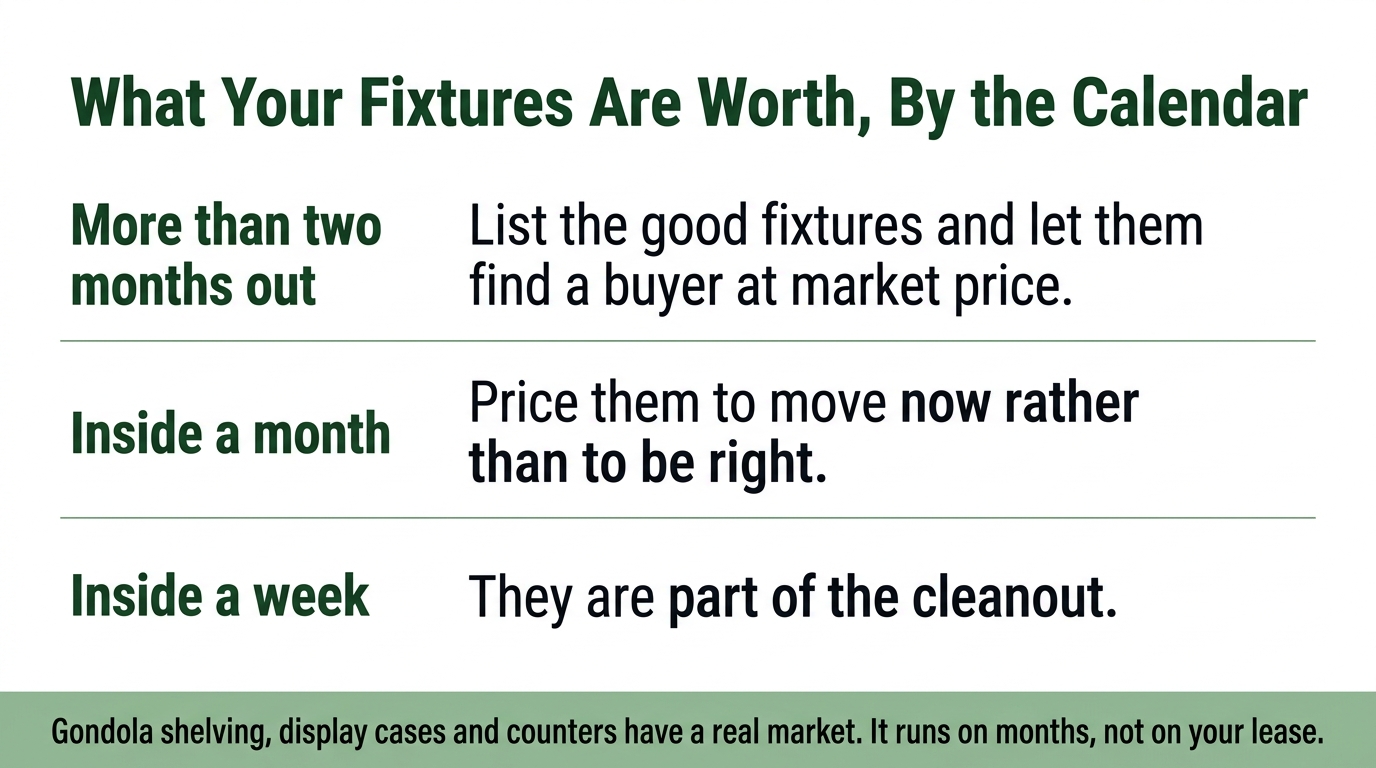
So the practical rule is a calendar rule. More than a couple of months out, list the good fixtures and let them find buyers. Inside a month, price them to move now rather than to be right. Inside a week, they are part of the cleanout, and pretending otherwise costs you the deadline.
Store closing on a lease deadline?
Veteran-owned crews strip fixtures, shelving and leftover stock in one visit, 5.0 rating across about 600 Google reviews, free on-site estimate.
What Fees Does a Columbus Landlord Add When a Store Is Left Unstripped?
Read the lease before you decide what stays, because the surrender clause usually says more than tenants remember.
Most retail leases require the space returned in a defined condition, commonly swept and clear of the tenant’s property, and many go further and require the tenant to remove its own alterations and restore the space toward the shell it was leased in. That can mean the slatwall you screwed to the wall, the counter you built and the signage on the storefront are your responsibility to take out, and the wall repairs behind them too.
Two consequences follow. First, leaving fixtures behind where the lease required their removal usually converts a cleanout you could have quoted into a deduction from your security deposit or a charge you had no say in. Second, and less obvious, the landlord may not want the space stripped at all: a fitted-out unit shows better to the next tenant than an empty shell. Ask before you strip, because the two outcomes are opposite and only one of them is written in the lease.
Either way the answer comes from the document rather than from custom. Get the clause in front of you before you book anybody.
How Do Columbus Strip Center Rules Add Cost to a Store Cleanout?
A strip center or mall unit adds constraints that a standalone building does not, and they cost hours rather than dollars on a rate card.
Access windows. Centers frequently restrict loading to before opening or after closing so trucks are not working across a live customer frontage. That compresses the job into a fixed window and can push a one-visit cleanout into two.
Shared loading areas. Where several units share one rear service area, your truck may be waiting on a delivery for a neighboring store.
Route length. In an interior mall unit the carry from the storefront to the truck can be several hundred feet, and every item makes that trip.
Waste restrictions. The center’s shared trash enclosure is for a store’s day-to-day waste. Fixtures, shelving and construction debris are not permitted in it under most leases, which is exactly why the load leaves on a truck.
Tell us the center’s rules when you book so the crew and the window are scheduled around them in advance. Discovering them on the morning is what turns a single visit into two.
How Early Should a Closing Columbus Store Get a Cleanout Estimate?
As soon as you know your last day of trading, and earlier than that if you intend to sell fixtures.
The reason is the resale clock rather than our availability. If you want the shelving to fetch anything, the listing has to run while the store is still open and the fixtures are still installed and photographable. That is weeks, not days. The cleanout itself can be booked much later, and we work to lease deadlines every week, including same-day service where the date demands it.
A free walkthrough early gives you two numbers to plan against: what the cleanout costs if you sell nothing, and what it costs if the good fixtures go. The difference between those is what your resale effort is worth, and it is better to know it before you spend three weekends photographing shelving.
For operators closing more than one Columbus location, we handle repeat work through our commercial cleanout crews, and we serve the wider market from our base through junk removal across Columbus.
The Bottom Line on Columbus Retail Store Cleanout Costs
A store cleanout is priced by volume in the truck, and volume is fixtures plus whatever stock did not sell.
So work the calendar. If you have months, list the gondola runs and the cases and let them sell properly. If you have weeks, price them to move today rather than holding out for what they are worth. If you have days, they are part of the load. Read the surrender clause before you decide what stays, ask the landlord whether they want any of it, run the closing sale down hard, flatten the packaging, and tell us the center’s access rules when you book.
We are veteran-owned, founded in 2020, and we carry general liability and workers’ compensation insurance on every job, with a certificate available on request. We hold a 5.0 rating across about 600 Google reviews, we price by truck volume across twelve price points, and the on-site estimate is free with no obligation.