If you’ve got an old TV, computer, or printer sitting in your garage, you’re not alone — and you might be wondering whether tossing it in the trash is actually legal in Indiana. The state’s e-waste law, codified under IC 13-20.5, created the Indiana E-Cycle Program to keep hazardous electronics out of landfills, but the rules aren’t always straightforward. This guide breaks down exactly what the law requires, who it applies to, what happens if you violate it, and — most importantly — where and how to recycle your electronics affordably across the state.
Electronics or e-waste to dispose of?
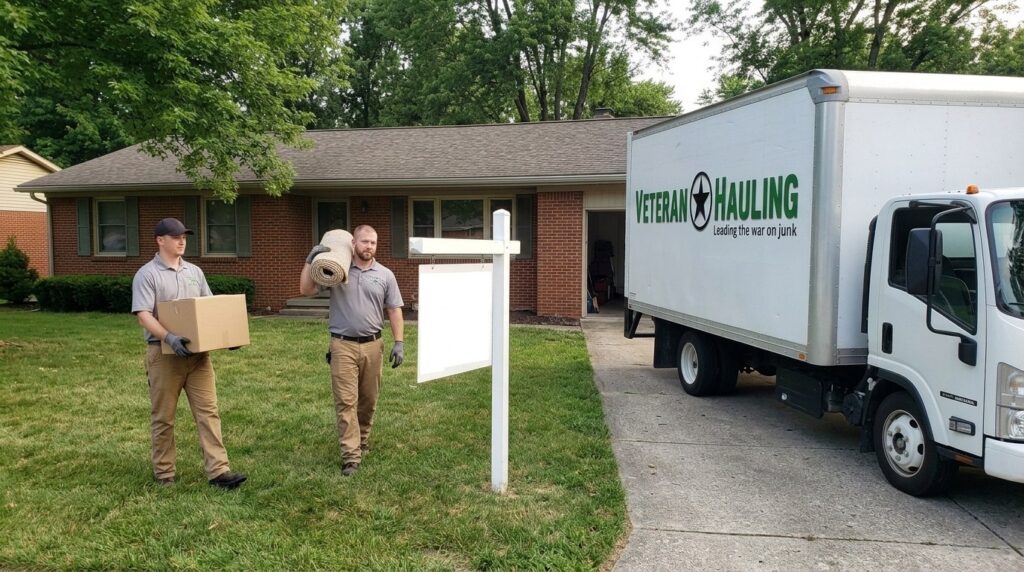
Veteran-owned, 600+ five-star reviews. We haul TVs, monitors, refrigerators, and other regulated items to certified recyclers, free on-site quote.
What Does Indiana’s E-Waste Law IC 13-20.5 Actually Say?
Overview of the Indiana E-Cycle Program
Enacted in 2009 and implemented in 2011, IC 13-20.5 established a manufacturer-responsibility framework for electronic waste recycling in Indiana. As outlined in the Indiana E-Cycle Retailer Toolkit, the law requires electronics manufacturers to register with IDEM and fund collection and recycling programs for covered electronic devices (CEDs) and video display devices (VDDs).
Covered devices include televisions, computer monitors, laptops, desktops, tablets, e-readers, and portable DVD players. However, not all electronics fall under this law — phones, printers, and batteries are governed by different guidelines.
Clarifying IC 13-20.5 vs. the Older IC 13-20.2
IC 13-20.2 was an earlier statute addressing general solid waste management, while IC 13-20.5 specifically targets electronic waste and manufacturer take-back obligations. Indiana’s environmental quality service archives provide additional context on how earlier legislative discussions shaped the state’s approach to waste management. Some online sources conflate the two, so always reference IC 13-20.5 for current e-waste recycling requirements.
Legislative updates through 2024–2025 have refined manufacturer registration thresholds but have not fundamentally changed the program’s structure.
How Indiana’s Law Compares to Neighboring States
Unlike Illinois and Michigan, Indiana does not impose a blanket landfill ban on all electronics, which creates confusion about legality. Ohio has no statewide e-waste law at all, while Kentucky relies on voluntary programs — Indiana’s manufacturer-responsibility model sits in the middle. Businesses operating across state lines should verify compliance in each state, as requirements differ significantly.
Is It Actually Illegal to Throw Away Electronics in Indiana?
The Landfill Ban Question
Indiana does not have a universal landfill ban on electronics for households. However, certain hazardous components — lead, mercury, hexavalent chromium — in electronics can trigger disposal restrictions under state and federal hazardous waste rules, as noted in the IDEM 2014 annual report.
Many local landfills and municipal waste haulers voluntarily refuse electronics, effectively creating a de facto ban in many counties. The law strongly encourages recycling through manufacturer-funded free collection but stops short of criminal penalties for individual household disposal in most cases.
Penalties and Enforcement for Improper Disposal
Manufacturers who fail to register or meet collection targets face fines and program suspension through IDEM enforcement. Businesses that improperly dispose of electronics containing hazardous materials can face penalties under Indiana’s solid waste management rules and federal RCRA regulations.
While individual residents are unlikely to face direct fines, improper disposal can result in rejected loads at transfer stations and potential local ordinance violations. A McCordsville waste management presentation illustrates how individual municipalities communicate these restrictions to residents.
Who Is Covered Under the Law
The E-Cycle Program covers three groups: households, public schools (K–12), and small businesses with 50 or fewer employees. Large businesses and enterprises are excluded from the free manufacturer-funded program and must handle e-waste under RCRA and state hazardous waste generator rules.
Public schools can access free collection through manufacturer-sponsored events — a benefit many administrators don’t realize exists.
What Electronics Can You Recycle and How Do You Do It Step by Step?
TVs, Monitors, and Video Display Devices
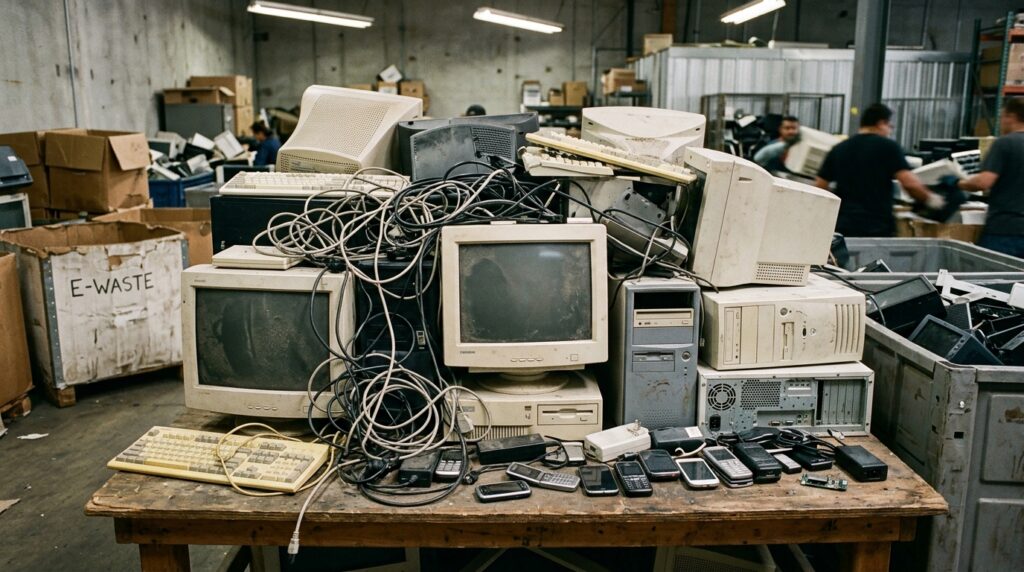
CRT televisions and monitors are the most common and often the most expensive items to recycle. Expect fees of $20–$50 at many drop-off locations due to high processing costs for leaded glass.
Flat-screen TVs (LCD, LED, plasma) are generally accepted free or at lower cost through manufacturer-funded programs and TV and e-waste disposal services. Remove all cables, check your county’s drop-off schedule, and transport the device yourself or schedule a pickup through a certified recycler.
Computers, Laptops, and Phones
Desktops and laptops are covered devices under IC 13-20.5 and are accepted at most free collection sites statewide. Smartphones and tablets are not explicitly covered under the E-Cycle Program but are accepted by most recyclers and through carrier take-back programs.
Before recycling, perform a factory reset, remove SIM and SD cards, and use data-wiping software such as DBAN for hard drives to protect personal information.
Printers, Batteries, and Other Peripherals
Printers, scanners, and peripherals are not classified as CEDs or VDDs under IC 13-20.5 but are accepted at many e-waste collection events and by private recyclers. Batteries — especially lithium-ion — must never go in regular trash or curbside recycling due to fire risk, so use dedicated battery recycling drop-offs as described in Indianapolis’s recycling 101 guide.
Cables, keyboards, and mice can often be bundled with computer drop-offs at no additional charge.
Where Can You Recycle Electronics in Indiana — Free and Paid Options?
Free Manufacturer-Sponsored Drop-Off Sites and Events
IDEM maintains a list of permanent collection sites funded by manufacturers under the E-Cycle Program, available in many Indiana counties including through Allen County’s electronics recycling. Annual community collection events are held throughout the state, often in spring and fall — check your county solid waste district website for upcoming dates.
Public schools can arrange free bulk pickups by contacting registered manufacturers or IDEM directly.
Paid Recycling Services and Cost Expectations
Free options typically cover flat-screen TVs, computers, and laptops, while CRT monitors and TVs almost always carry a fee due to hazardous material processing costs. Private recyclers and pickup services offer convenient alternatives across the state, including junk removal in Indianapolis, junk removal in Bloomington, junk removal in Columbus, and junk removal in Indianapolis.
Residents in the northern suburbs can also find junk removal in Carmel, junk removal in Fishers, and junk removal in Indianapolis. For large appliances with electronic components, appliance removal services and junk removal in Indianapolis can handle items that don’t fit standard e-waste programs.
Statewide Directory Beyond the Indianapolis Metro
Rural Indiana residents can contact their county solid waste management district for the nearest drop-off — every county has a designated contact through IDEM. Some counties partner with neighboring districts to share collection infrastructure, meaning your nearest site may be in an adjacent county.
For commercial and residential clients across broader regions, Reworx Recycling in Indiana is one option to consider.
Electronics or e-waste to dispose of?
Veteran-owned, 600+ five-star reviews. We haul TVs, monitors, refrigerators, and other regulated items to certified recyclers, free on-site quote.
How Can You Protect Your Data and Ensure Responsible Recycling?
Data Security Before You Recycle
Always back up important files, then perform a full factory reset on phones, tablets, and laptops before turning them over to any recycler. For hard drives containing sensitive data, use NIST 800-88 compliant data destruction software or physically destroy the drive.
Small businesses and schools should document data destruction with certificates of destruction from their recycler to maintain compliance with privacy regulations.
What Happens to Your E-Waste After Collection
Collected devices are sorted, tested for reuse potential, and then dismantled — metals, plastics, and glass are separated for commodity recycling. Indiana’s report on decommissioning solar and wind equipment.pdf) highlights how the state is also grappling with end-of-life management for newer energy technologies alongside traditional e-waste. Reputable recyclers hold R2 or e-Stewards certification, which ensures responsible downstream processing and prohibits export to developing countries for unsafe dismantling.
Ask your recycler about their certifications and downstream vendor chain — transparency on this point is a sign of a trustworthy operation.
What Should You Do Right Now to Stay Compliant and Recycle Responsibly?
For Indiana residents: While Indiana doesn’t impose a blanket landfill ban on household electronics, the law strongly incentivizes recycling through free manufacturer-funded programs — and hazardous materials in your devices may make disposal illegal in practice. Wipe your data, check your county’s drop-off options via resources like Indianapolis’s trash 101 guide, and take advantage of free collection events before paying for disposal.
For small businesses: If you have 50 or fewer employees, you qualify for the same free E-Cycle Program as households — use it. Larger businesses must comply with RCRA hazardous waste rules and should partner with a certified commercial e-waste recycler to avoid penalties.
For public school administrators: Contact IDEM or registered manufacturers to schedule free bulk electronics pickups at least once per year. This benefit is built into the law specifically for K–12 schools, and it costs nothing to take advantage of it.
Bookmark your county solid waste district’s website and IDEM’s E-Cycle page for updated event calendars and site locations — staying informed is the easiest step toward staying compliant.